The Quest to Find the Most Adorably Cute Creatures
I’ve spent way too many hours debating which animal deserves the crown for cutest creature alive. It’s one of those arguments that never really ends, and honestly, I don’t want it to. Every corner of the globe has its own adorable contenders — from the bamboo forests of central China to the scrublands of western Australia. Some win you over with big eyes. Others do it with goofy behavior. A few sneak up on you because they’re just so vulnerable you can’t help but care. Cuteness is personal, sure, but there are a handful of species that seem to melt just about everyone.
Characteristics of Cuteness
Before we jump into specific animals, it helps to understand why we react the way we do. There’s actual science behind it. Big eyes, squishy round faces, tiny mouths, and soft-looking bodies — these features flip a switch in our brains. They trigger something protective in us, almost parental. Researchers think it’s because those traits remind us of human infants, and we’re wired to respond. It’s not just a feeling. It’s evolution doing its thing.
What I find fascinating is how consistent this is across cultures. Doesn’t matter if you grew up in Tokyo or Toronto — a round-faced animal with big eyes is going to grab your attention. That’s powerful stuff, and it shapes everything from which animals get conservation funding to which ones blow up on social media.
Pandas: The Poster Child of Cuteness
You can’t write about cute animals without talking about pandas. I mean, come on. That black and white coloring, those round bodies, the way they just sit there munching bamboo like they don’t have a care in the world — it’s impossible not to smile. Giant pandas live in the mountain forests of central China, and they spend most of their day eating. We’re talking 12 to 16 hours of bamboo consumption. Every. Single. Day.
They move slowly and deliberately, almost like they’re in on the joke. I’ve watched footage of panda cubs tumbling down hills and rolling off platforms, and it never gets old. Their clumsy playfulness combined with that unbothered attitude is basically the recipe for maximum cuteness. There’s a reason the World Wildlife Fund chose a panda for its logo — these animals are conservation royalty.
Quokkas: The Happiest Animal
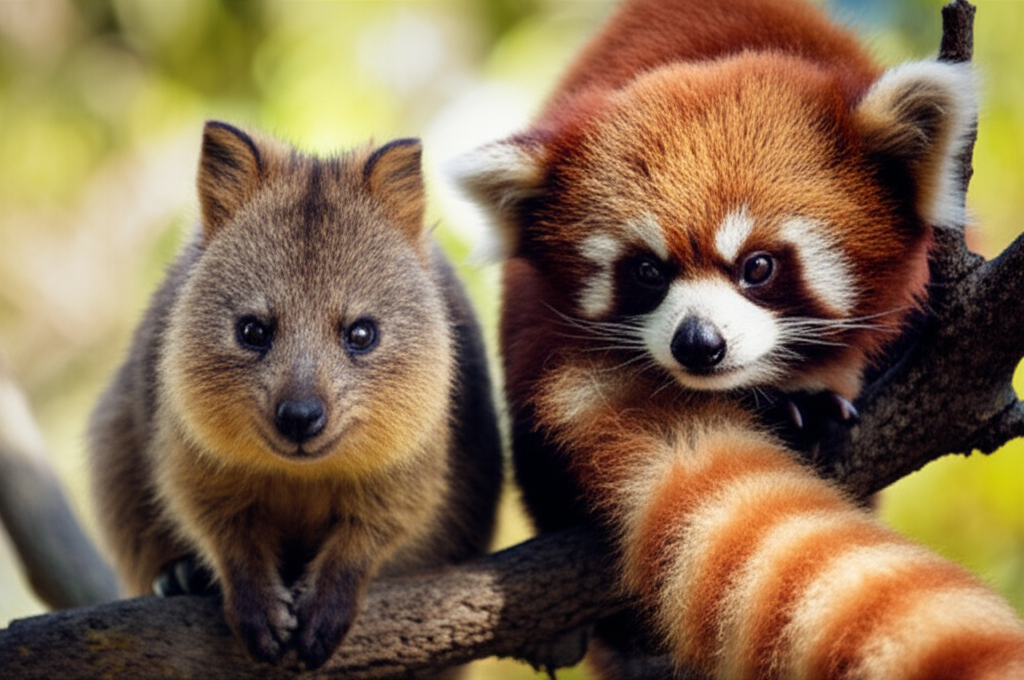
If you haven’t seen a quokka yet, you’re in for a treat. These little marsupials live mainly on Rottnest Island off the coast of western Australia, and they’ve earned the nickname “the happiest animal on Earth.” Why? Because their mouths naturally curve upward, so they always look like they’re smiling. It’s almost unfair how photogenic they are.
Quokkas are about the size of a domestic cat. They’ve got soft brown fur, chunky little bodies, oversized hind legs, and strong tails that help them hop around like miniature wallabies. What really sets them apart, though, is their personality. They’re genuinely friendly. They’ll walk right up to you without hesitation, which is why tourists can’t resist snapping selfies with them. I should note that you’re not supposed to touch or feed them — they’re still wild animals — but their approachability is part of what makes them so irresistible.
Red Pandas: The Lesser-Known Panda
Red pandas don’t get nearly enough love, and I’ll fight anyone who disagrees. They share part of their name with giant pandas, but that’s about where the similarities end. These guys are smaller, roughly the size of a large house cat, and they live in the temperate forests of the Eastern Himalayas. Their reddish-brown fur and those beautifully ringed bushy tails are striking. Really striking.
I think what draws me to red pandas is their personality. They’re tree dwellers, spending most of their time climbing around branches or — and this is the best part — sleeping. They curl up in the most ridiculous positions, wrapping their tails around themselves like fluffy scarves. Their pointed ears and sweet facial expressions give them a permanently curious look. And here’s a fun detail I love: when a red panda feels threatened, it’ll stand up on its hind legs to look bigger. It’s meant to be intimidating, but honestly, it just makes them look even cuter. That combination of bravery and adorableness is hard to beat.
Fennec Foxes: Tiny Foxes of the Desert
Fennec foxes are the smallest fox species on the planet, and they call the Sahara Desert and other parts of North Africa home. Everything about them seems designed to be adorable, even though it’s really all about desert survival. Their cream-colored fur reflects sunlight to keep them cool, and those enormous ears? They’re not just for show. Those ears radiate body heat and help the fox regulate its temperature in brutal conditions.
But let’s be real — the reason we’re all obsessed with fennec foxes is the contrast between their teeny tiny bodies and those absolutely massive ears. It’s comical. They look like someone stretched a Chihuahua’s ears to cartoon proportions. Beyond their looks, these little foxes are playful and surprisingly vocal. They bark, they chirp, they make this bizarre purring sound that sounds nothing like what you’d expect from a fox. I’ve spent more time than I’d like to admit watching fennec fox videos, and I don’t regret a second of it.
Baby Animals: Cuteness Overload
Now, I need to talk about baby animals because this is where cuteness truly goes off the charts. Adult animals are great, but throw a baby into the mix and something shifts in your brain. Here are a few that consistently wreck me:
- Tiger Cubs: Those wide, curious eyes paired with oversized paws they haven’t grown into yet — tiger cubs are mesmerizing. Even people who’ve worked with big cats their entire careers admit they never get used to how adorable the cubs are.
- Piglets: Don’t underestimate piglets. Whether they’re charging through mud puddles or nudging up against their mom, they’ve got this playful energy that’s absolutely infectious. They’re smarter than most people realize, too.
- Ducklings: There’s something about a line of ducklings waddling behind their mother that hits different. When one trips and tumbles, then scrambles to catch up? That’s pure innocence captured in a moment.
- Seal Pups: I might be biased, but seal pups are near the top of my personal list. Those huge dark eyes staring up at you from a bed of ice or from shallow water — it’s impossible to look away. Their soft white fur doesn’t hurt either.
The Role of Cuteness in Conservation
Here’s where things get a bit complicated, and I think it’s worth being honest about it. Cute animals absolutely benefit from conservation efforts more than their less photogenic counterparts. When an organization needs to raise money, they’re going to put a panda or a baby seal on the poster — not a blobfish or a naked mole rat. And that strategy works. Donations pour in, awareness campaigns gain traction, and protected habitats get established.
The problem is that plenty of critically important species don’t look cuddly at all. Insects, amphibians, deep-sea creatures — they’re doing essential work for their ecosystems, but they don’t generate the same emotional response. I’m not saying we should stop caring about pandas. But I do think we need to be more intentional about spreading our conservation efforts across the board. A balanced approach protects entire ecosystems rather than just the species that make us go “aww.”
The Intriguing Research on Animal Cuteness
So why exactly do we find certain animals cute? It’s not random, and scientists have been poking at this question for decades. Back in 1943, Konrad Lorenz, an Austrian ethologist who really pioneered this field, introduced the concept of kindchenschema — or “baby schema.” His argument was straightforward: features that resemble those of human infants (big head, large eyes, round cheeks) trigger an automatic caregiving response in adults. And it doesn’t just work with human babies. It works across species.
Modern studies have confirmed what Lorenz proposed. Brain imaging shows that looking at baby-like features in animals activates the same reward centers that light up when parents look at their own children. That’s wild to me. It means our response to a fluffy kitten isn’t just cultural or learned — it’s baked into our neural wiring. This explains why cute animal imagery is so effective in advertising, product design, and media. Marketers figured this out a long time ago, and they haven’t stopped exploiting it since.
The Impact of Human Interaction with Cute Animals
I’ve visited my fair share of zoos and wildlife sanctuaries, and I can tell you firsthand — the cute animals are always the main draw. The panda exhibit always has the longest line. The otter enclosure is always packed. It’s just how it works. Tourism around wildlife has become a massive industry, and a big chunk of it is driven by people wanting to see these adorable creatures in person.
The good facilities have figured out how to balance visitor engagement with animal welfare. They offer educational programs alongside the experience, so visitors leave understanding why these animals matter beyond just being cute. That said, there are plenty of places that haven’t gotten the memo, and we need to be choosy about where we spend our money. Not every “sanctuary” is what it claims to be.
Online Influence and Iconic Animal Ambassadors
The internet changed everything for cute animals, and I don’t think that’s an exaggeration. Before social media, you’d see a cute animal on a nature documentary or maybe a calendar. Now? Your feed is basically a nonstop parade of kittens, puppies, baby goats, and otters holding hands. Videos of animals doing something silly or sweet are practically guaranteed to go viral.
Some animals have become genuine celebrities because of this. Grumpy Cat amassed millions of followers and spawned a merchandising empire. Boo the Pomeranian was dubbed “the world’s cutest dog” and had a book deal. Memes and GIFs featuring clumsy pandas, curious meerkats, and hyperactive puppies circulate endlessly. I’ve definitely lost entire evenings to these rabbit holes, and I know I’m not alone. The reach is staggering — a single cute animal video can rack up tens of millions of views in days.
The Double-Edged Sword of Viral Popularity
But here’s the thing I keep coming back to — all that viral attention isn’t always a good thing. Sure, it raises awareness about species that need protection, and it gets people emotionally invested in wildlife they’d never otherwise think about. That part is great. The ugly side, though, is that viral fame sometimes creates demand for exotic pets. When a slow loris video blows up online, suddenly everyone wants one. Never mind that they’re endangered and miserable in captivity.
I’ve seen this pattern repeat with fennec foxes, sugar gliders, and even otters. A cute clip goes viral, pet trade demand spikes, and wild populations suffer. It’s a frustrating cycle, and it’s why experts keep pushing for responsible content sharing. If you’re going to post or share animal content, it helps to pair it with a conservation message. It doesn’t have to be preachy — just a quick note about the species and why it matters in the wild.
Keeping Cute Animals Safe in the Digital Era
So what can we actually do about this? I’ve thought about it a lot, and I think it comes down to a few practical things:
- When you share a cute animal video, add some context. A quick line about the species and its natural habitat goes further than you’d think. It shifts the conversation from “I want one” to “I want to protect them.”
- Pair popular images and footage with links to actual conservation organizations. Make it easy for people to channel that emotional response into something productive.
- Speak up against the illegal wildlife trade whenever you encounter it, even in comment sections. Normalizing the idea that wild animals belong in the wild matters more than you’d expect.
- Support campaigns that spotlight less glamorous species too. The insects and fungi and bottom-feeders may not be cute, but they’re holding ecosystems together. They deserve attention and funding just as much as the photogenic ones.


Stay in the loop
Get the latest international wildlife research updates delivered to your inbox.