Today, I will share it all with you.
From rabbits darting through meadows to zebras thundering across the savanna, these prey animals aren’t just meals on legs — they’re the backbone of healthy ecosystems everywhere.
Why Prey Animals Matter More Than You’d Think
When most people think about wildlife, they jump straight to the lions, wolves, and eagles. I get it — predators are flashy. But here’s the thing: without prey animals, those predators wouldn’t last a single generation. Prey animals are the ones quietly holding everything together behind the scenes. They control plant growth through grazing, spread seeds across vast distances, and serve as the nutritional foundation for entire food webs. I’ve spent years reading about and observing these creatures, and the more I learn, the more I realize they deserve way more credit than they typically get.
Let’s dig into ten groups of prey animals that genuinely keep ecosystems running.
Small Mammals
Small mammals might not look like much, but they’re absolutely essential. These little guys form the caloric base for so many predator species that it’s almost hard to overstate their importance. I think of them as the engine room of terrestrial food webs.
Rabbits and Hares
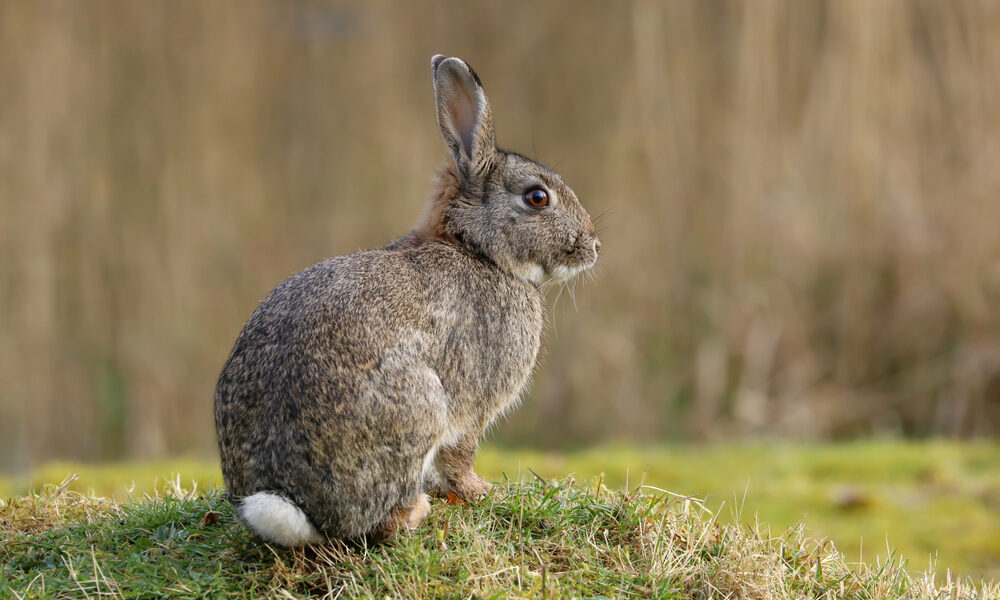
I’ve always had a soft spot for rabbits and hares. They’re found across nearly every continent, and they’ve figured out survival in a way that’s honestly impressive. Those powerful hind legs? They can launch a rabbit from zero to about 35 miles per hour in seconds. That’s not a casual jog — that’s a full-blown sprint. Their eyes sit on the sides of their heads, giving them almost 360-degree vision, so sneaking up on them is harder than you’d expect. They live in all sorts of habitats too — meadows, forests, deserts, tundra. You name it, there’s probably a lagomorph there. Their grazing habits shape plant communities in subtle but significant ways, keeping vegetation from getting overgrown in certain areas.
Rodents
Mice, rats, squirrels, voles — the rodent family is massive, and they’re everywhere. Forests, grasslands, cities, barns, attics. You really can’t escape them, and honestly, the ecosystem can’t function without them either. What makes rodents so critical is their reproduction rate. A single pair of mice can produce dozens of offspring in a year, which sounds alarming until you realize that hawks, owls, foxes, snakes, and countless other predators depend on that abundance to feed their own young. Squirrels, in particular, do this wonderful thing where they bury acorns and then forget about a good percentage of them — essentially planting trees without meaning to. I find that delightful.
Groundhogs
Woodchucks (same animal, different name — it confused me for years) are chunky, burrowing rodents native to North America. They’re a favorite meal for foxes, coyotes, bobcats, and large hawks. But here’s what a lot of people don’t realize: their burrow systems are incredible. We’re talking tunnels that can stretch 40 feet or more, with multiple chambers and exits. When a groundhog moves on, those abandoned burrows become homes for rabbits, skunks, opossums, and even snakes. So they’re basically building affordable housing for the rest of the wildlife community.
Birds
Pigeons are seen in urban environments worldwide.
Birds occupy this fascinating middle ground in food webs. Many of them are predators of insects and small invertebrates, but they’re also prey for larger raptors, mammals, and reptiles. It’s a tough gig, honestly — eat or be eaten, all day every day.
Songbirds
Warblers, finches, sparrows, thrushes — songbirds are some of the most colorful and melodic creatures on the planet. They’re also, unfortunately for them, a prime target for hawks, cats, and even larger songbirds. But they punch well above their weight ecologically. A single songbird can eat hundreds of insects per day, keeping pest populations in check. They also scatter seeds through their droppings as they fly from spot to spot. I’ve watched chickadees flit through winter branches, somehow surviving temperatures that would have me bundled under three blankets. Their flight ability gives them a real edge over ground-based predators, though aerial hunters like Cooper’s hawks have gotten terrifyingly good at ambushing them mid-flight.
Ducks
Ducks get hunted from just about every angle. Eagles and ospreys from above, snapping turtles from below, foxes from the shoreline, and yes — human hunters too. It’s a lot of pressure. Yet ducks thrive, and that’s partly because they’re incredibly versatile. They’ve got sharp eyesight, strong flight muscles for long migrations, and they’re comfortable in freshwater, saltwater, and everything in between. In aquatic ecosystems, ducks do really important work by stirring up sediment when they feed, redistributing nutrients, and consuming aquatic plants that might otherwise choke waterways. I’ve always thought mallards don’t get enough appreciation for how adaptable they are.
Pigeons
Okay, I know pigeons get a bad rap. “Rats with wings” and all that. But let me tell you something: pigeons are remarkable survivors. They’ve colonized cities on every inhabited continent, and they serve as a critical food source for urban-dwelling predators like peregrine falcons and sparrowhawks. In fact, peregrine falcon recovery programs in cities have succeeded largely because pigeons provide such reliable prey. Their flocking behavior creates safety in numbers — a predator has a harder time targeting one bird in a swirling mass of hundreds. And their navigation abilities? Some scientists still can’t fully explain how pigeons find their way home over vast distances. They’re genuinely impressive birds if you give them a fair chance.
Insects
Now we’re getting into the tiny powerhouses. Insects are the most abundant prey animals on the planet by a landslide, and I don’t think most people fully grasp how much of the living world depends on them. Without insects as prey, entire ecosystems would collapse within months.
Grasshoppers
Grasshoppers are basically protein bars with legs. Birds love them, lizards love them, frogs love them, and even small mammals will snap them up when the opportunity arises. They’ve got those massive hind legs that let them launch themselves several feet in a single bound, plus many species can blend into grasses and dried vegetation so well that you’ll walk right past them without noticing. Their reproductive rate is staggering — a single female can lay hundreds of eggs. That sounds like an invasion (and sometimes it is — ever heard of locust swarms?), but under normal conditions, all those grasshoppers feed an enormous web of predators. The whole system depends on it.
Ants
I once read that the total biomass of ants on Earth might rival that of humans. Let that sink in for a second. Ants are consumed by an astonishing variety of animals: anteaters (obviously), birds, lizards, spiders, bears, and even other ants. They’re packed with protein and exist in such enormous numbers that they’re essentially an all-you-can-eat buffet for anything small enough — or specialized enough — to exploit them. Their colony structures are wildly complex, with queens, workers, soldiers, and sometimes even farmers tending fungal gardens. They aerate soil, recycle nutrients, and serve as prey all at the same time. Multi-tasking at its finest, if you ask me.
Crickets
You’ve heard crickets chirping on warm summer nights. That sound — as peaceful as it is for us — is basically a dinner bell for predators. Reptiles, amphibians, birds, and spiders all zero in on that chirping. Crickets know this, which is partly why they’re nocturnal; it’s safer to move around when fewer visual hunters are active. But nocturnal predators like owls and bats still find them just fine. Crickets are a staple food in the reptile pet trade too, which tells you something about their nutritional value. In the wild, they break down plant material and recycle organic matter back into the soil, performing a cleanup role that doesn’t get talked about nearly enough.
Amphibians
Amphibians sit at this really interesting crossroads in the food web. They’re predators of insects and other small invertebrates, but they’re also preyed upon by a wide range of animals. Their dual life — water and land — means they face threats in both environments. It’s not easy being green, as the saying goes.
Frogs
Frogs are consumed by just about everything: birds, snakes, raccoons, larger frogs, fish, and even some large spiders. Their first line of defense is usually camouflage — many species blend perfectly into leaf litter, bark, or aquatic vegetation. Some have gone a completely different route, though, developing bright warning colors backed up by toxic skin secretions. Poison dart frogs in Central and South America are the most famous example. You look at one of those tiny neon-colored frogs and think “cute,” but predators have learned to think “absolutely not.” Frogs also keep insect populations in check, devouring mosquitoes, flies, and beetles by the hundreds. Their decline worldwide is actually a huge ecological concern, because when frogs disappear, insect populations can boom in really problematic ways.
Toads
Toads are the frogs’ tougher, wartier cousins. That bumpy skin isn’t just for looks — it contains glands that produce toxins, making toads a less appealing meal for many predators. Still, plenty of snakes, birds, and mammals have figured out ways around those defenses. Some snakes are completely immune to toad toxins, and certain birds have learned to flip toads over and eat them from the belly side, avoiding the toxic glands entirely. Clever, right? Toads are voracious insect eaters, patrolling gardens and fields at night, gobbling up slugs, beetles, and other pests. I always appreciate finding a toad in my yard. It means nature’s pest control is on the job.
Fish
When we shift to aquatic ecosystems, the scale of prey dynamics is mind-boggling. Small schooling fish form the nutritional backbone of the world’s oceans, and they do it in numbers that are hard to even comprehend.
Anchovies
Anchovies are tiny fish with an outsized ecological footprint. They travel in enormous schools — sometimes millions strong — and serve as food for tuna, swordfish, dolphins, sea lions, pelicans, and humpback whales. Their streamlined bodies make them fast swimmers, but when you’re being hunted by everything from seabirds above to sharks below, speed alone doesn’t cut it. Schooling behavior is their main defense: that swirling mass of silver confuses predators and makes it hard to single out one individual. Ecologically, anchovies are a critical link in the food chain because they feed on plankton and convert that microscopic energy into a form that larger animals can actually use. Without anchovies, a lot of the ocean’s bigger players would be in serious trouble.
Sardines
Sardines play a similar role to anchovies, and the two species often share the same waters. If you’ve ever seen footage of a sardine run off the coast of South Africa, you know what I’m talking about — billions of sardines migrating along the coastline, pursued by dolphins, sharks, gannets, and whales in one of the greatest wildlife spectacles on the planet. It’s genuinely breathtaking. Sardines use their schooling instinct as protection, creating bait balls that can be dozens of feet across. They bridge the gap between microscopic plankton and the large marine predators that people tend to care about. In that way, sardines are doing the heavy lifting that keeps entire ocean food webs functional.
Reptiles
Reptiles as prey animals is something people don’t always think about. We tend to picture reptiles as the hunters — snakes striking, crocodiles lunging. But plenty of smaller reptile species spend their lives looking over their shoulders (figuratively, anyway).
Lizards
Small lizards are on the menu for an impressive range of predators: birds of prey, snakes, larger lizards, mammals, and even some large spiders. They’ve developed some genuinely creative survival tactics over millions of years. The most famous is tail autotomy — the ability to voluntarily detach their own tail when grabbed. The severed tail keeps wriggling, distracting the predator while the lizard makes its escape. It grows back eventually, though the replacement is never quite as nice as the original. Lizards also provide crucial pest control by consuming insects, spiders, and other small invertebrates. In tropical ecosystems especially, they’re one of the main forces keeping bug populations from spiraling out of control.
Geckos
Geckos are fascinating little reptiles, and I honestly think they don’t get enough attention outside of car insurance commercials. They can climb vertical glass surfaces thanks to microscopic hair-like structures on their toe pads — a trick that scientists are still trying to replicate in adhesive technology. Like other small lizards, they can drop their tails to escape predators, and the tail regenerates over time. Hawks, owls, snakes, and larger lizards all prey on geckos, especially at night when many gecko species are most active. In homes and gardens throughout tropical and subtropical regions, geckos are welcomed because they eat mosquitoes, cockroaches, and moths. They’re basically little pest-control machines scurrying along your walls.
Large Herbivores
This is where prey animals get really dramatic. The large herbivores of Africa and other continents are the ones most people picture when they hear “prey animal,” and for good reason — the predator-prey dynamics at this scale are absolutely riveting.
Deer
Deer are found across North America, Europe, Asia, and South America, and they’re a primary food source for apex predators like wolves, mountain lions, and bears. Their survival strategy is a combination of speed, keen senses, and blending into forested environments. A white-tailed deer can hit 30 miles per hour in a sprint, and their hearing is sharp enough to detect a twig snapping from a remarkable distance. What I find really interesting about deer is their ecological impact as grazers and browsers. They shape forest understories by selectively eating certain plants, which influences which tree species succeed and which don’t. In areas where deer populations have exploded due to predator removal, you can actually see the damage — forests that can’t regenerate because every sapling gets munched before it grows tall enough. It’s a perfect example of why prey animals and predators need each other.
Antelopes
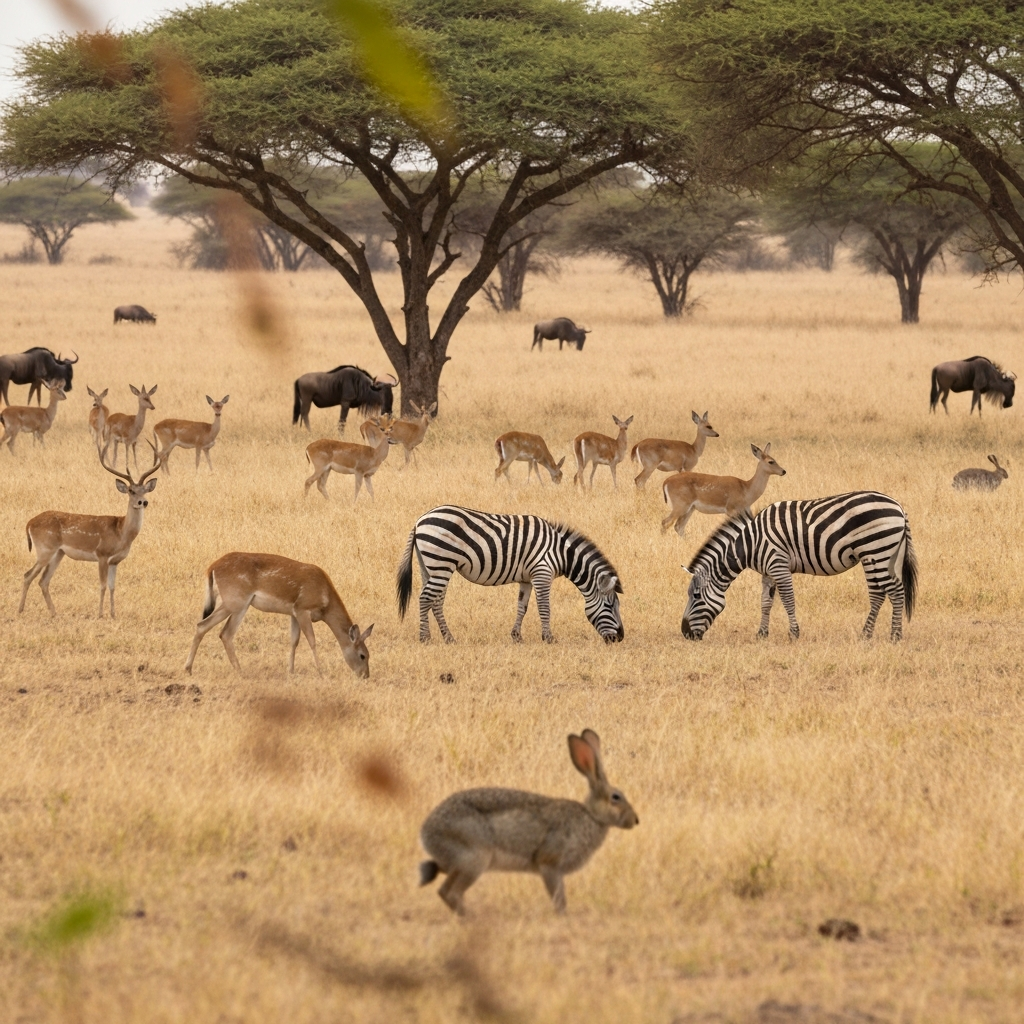
Africa’s antelopes come in an incredible range of sizes and shapes, from the tiny dik-dik (barely a foot tall) to the massive eland (which can weigh over a ton). They’re hunted by lions, leopards, cheetahs, hyenas, wild dogs, and crocodiles — basically the entire predator lineup of the African savanna. Speed and agility are their go-to defenses. A springbok can reach 55 miles per hour and performs this incredible leaping display called “pronking” that may signal to predators: “I’m fit, don’t bother chasing me.” Antelopes shape their grassland environments through grazing, preventing any single plant species from dominating and maintaining the biodiversity that so many other animals depend on.
Zebras
Zebras might be the most visually striking prey animal on the planet. Those black-and-white stripes have puzzled scientists for decades. The latest research suggests they help deter biting flies, which carry diseases — a surprisingly practical solution dressed up in bold fashion. Lions, hyenas, and crocodiles are their main threats, and zebras will kick, bite, and fight back harder than you might expect for a “prey” animal. I once watched footage of a zebra stallion fending off a young lion, and honestly, the lion looked like it regretted its life choices. As grazers, zebras are incredibly important. They often eat the taller, tougher grasses that other herbivores won’t touch, essentially mowing the lawn so that shorter, more nutritious grasses can grow for wildebeest and antelopes. It’s this cooperative grazing pattern that keeps the savanna productive and diverse.
The Big Picture: Why Every Prey Species Counts
Here’s what I keep coming back to after all my years of wildlife research: these prey animals aren’t just victims in some nature documentary chase scene. They’re active participants in shaping the world around them. Rabbits sculpt meadow vegetation. Sardines transfer oceanic energy from microscopic to massive scales. Ants recycle nutrients beneath our feet. Zebras engineer grasslands. Every single one of these creatures plays a role that, if removed, would send ripple effects through the entire ecosystem.
The next time you see a rabbit bolt across a field or watch a flock of pigeons take off from a park bench, I hope you’ll think about the bigger picture. These animals aren’t just running or flying away from danger — they’re keeping the whole system in balance, one heartbeat at a time. And that, I think, is pretty remarkable.


Stay in the loop
Get the latest international wildlife research updates delivered to your inbox.