Today, I will share it all with you.
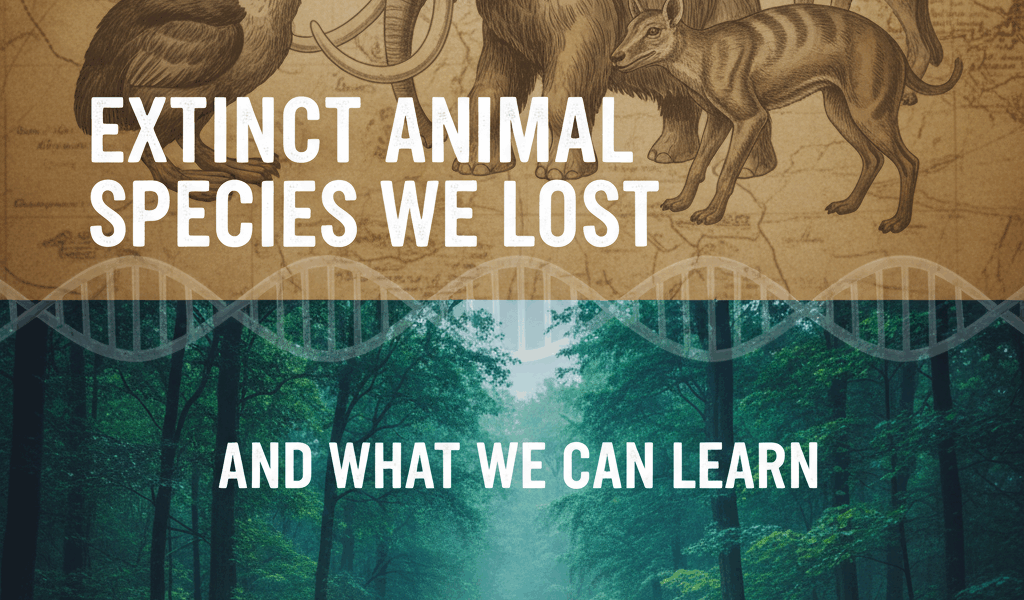
Here’s the thing that keeps me up at night sometimes — roughly 99 percent of every species that has ever existed on this planet? Gone. Vanished. That’s just how evolution works. But the rate we’re losing species right now is absolutely bonkers compared to anything the fossil record shows us. And when you start digging into the stories of individual animals — the woolly mammoth trudging across frozen tundras, the passenger pigeon literally blotting out the sun in flocks of billions — it hits different. These aren’t just statistics. They’re cautionary tales about ecological relationships, environmental shifts, and yeah, our own impact on this planet.

Recent Extinctions That Totally Changed the Conservation Game
The past few hundred years have seen extinctions that genuinely shocked people — scientists and regular folks alike. What makes these losses so valuable (if that’s even the right word) is that they happened within recorded history. We have documentation. We have dates. We have names. And honestly, that makes them hurt more.
The Thylacine – Tasmania’s Lost Predator
Okay, the thylacine might be the one that gets me the most. Commonly called the Tasmanian tiger because of those incredible stripes on its back, this animal was the largest carnivorous marsupial of modern times. We’re talking adults that weighed up to 30 kilograms and stretched nearly two meters from snout to tail tip. Just a stunning creature.
They used to roam all across mainland Australia, New Guinea, and Tasmania. By the time Europeans showed up, though, they were already down to just Tasmania. And then things got really bad. Farmers thought they were killing livestock — some were, sure, but the response was wildly disproportionate. The Tasmanian government literally put bounties on them. Between 1888 and 1909, they paid out bounties for 2,184 thylacine scalps. Two thousand one hundred eighty-four. Let that number sink in.
The last known thylacine, a male they called Benjamin, died at the Hobart Zoo on September 7, 1936. Want to know the gut-wrenching part? The species had been given protected status just 59 days before that. Fifty-nine days too late. The thylacine’s story shows just how fast targeted persecution can wipe out a species that survived millions of years of natural selection.
The Dodo – The Original Poster Child for Human-Caused Extinction
I mean, you can’t write about extinct animals without talking about the dodo, right? No extinct animal is more closely tied to the concept of extinction itself. This chunky, flightless bird lived on the island of Mauritius in the Indian Ocean, and it evolved without any natural predators. About a meter tall, weighing between 10 and 18 kilograms, the dodo had completely lost the ability to fly over thousands of years of island life. Why bother flying when nothing’s trying to eat you?
Then Dutch sailors landed in Mauritius in 1598. The dodo wasn’t afraid of them. Why would it be? It had never encountered a predator in its entire evolutionary history. Within less than a century — by the 1660s — the species was completely gone. Direct hunting was part of it, but the pigs, rats, and monkeys that sailors brought along absolutely devastated the dodo’s ground-level nests.
The phrase “dead as a dodo” became part of everyday language, and honestly, it’s a grim reminder that millions of years of evolution can be undone in a few decades of carelessness.
The Passenger Pigeon – From Literally Billions to Absolutely Zero
This one blows my mind every single time I think about it. The passenger pigeon was the most abundant bird on Earth. Not by a little. By a lot. We’re talking an estimated 3 to 5 billion individuals. Their flocks were so massive that they’d darken the sky for hours as they passed overhead, creating a sound you could hear from miles away.
Naturalist John James Audubon described a flock in 1813 that took three full days to pass, and he estimated it contained over a billion birds. A billion. In one flock. Native Americans had hunted passenger pigeons sustainably for thousands of years — it was totally fine. Then European colonization brought commercial hunting at an industrial scale that was just… I don’t even have words for it.
They shipped pigeons by the trainload to cities. Sold them for a penny each. Meanwhile, deforestation was wiping out their nesting habitat and telegraph lines let hunters track and intercept migrating flocks in real time. The population went from billions to thousands in just a few decades. The last passenger pigeon, a female named Martha, died at the Cincinnati Zoo on September 1, 1914. From billions to one. Then to zero.
Ice Age Giants and the Woolly Mammoth

When the last Ice Age ended roughly 11,700 years ago, the world lost a whole roster of enormous mammals — the megafauna. And I’m not exaggerating when I say these were some of the most incredible animals to ever walk this planet. Their disappearance changed ecosystems on every single continent.
The Woolly Mammoth
I’ve been fascinated by woolly mammoths since I was a kid looking at picture books, and the real facts are even more incredible than anything I imagined back then. These animals stood up to 3.4 meters at the shoulder and weighed up to 6 tonnes. They had thick fur coats, tiny ears (to prevent heat loss — clever, right?), and a layer of fat up to 10 centimeters thick. They ranged all across northern Eurasia and North America.
But here’s the fact that always stops people in their tracks when I mention it: woolly mammoths survived way longer than most people think. The mainland populations died out around 10,500 years ago, sure, but isolated groups hung on. The last known mammoths lived on Wrangel Island in the Arctic Ocean until about 4,000 years ago. That means mammoths were still alive when the Egyptian pyramids were being built. Wild, right?
Scientists are still arguing about whether climate change or human hunting did them in. Most evidence points to a combination of both — the warming climate shrank their habitat while human hunters finished off what was left.
Other Ice Age Megafauna
The woolly mammoth definitely gets the headlines, but it wasn’t alone. Not even close. North America lost about 35 genera of large mammals. Giant ground sloths weighing up to 4 tonnes. Sabertooth cats. American lions that were actually larger than modern African lions. Giant short-faced bears. Glyptodonts the size of small cars. Just incredible creatures, all gone.
South America got hit even harder, losing over 50 genera of large mammals. Australia lost its megafauna even earlier — giant wombats, marsupial lions, and the enormous Diprotodon, which holds the title of largest marsupial ever known. I sometimes try to imagine what a walk through the woods would’ve looked like back then and it’s just… a completely different world.
These extinctions didn’t just remove cool animals from the landscape. They fundamentally reshaped ecosystems worldwide. Here’s something that absolutely fascinated me when I first learned about it: many plants evolved fruits that were specifically designed to be eaten and dispersed by megafauna that no longer exist. Ecologists call these “evolutionary anachronisms” — fruits waiting for seed dispersers that went extinct thousands of years ago. Nature’s still holding the door open for animals that aren’t coming back.
Dinosaurs and Mass Extinction Events
Recent extinctions grab our attention because they feel personal. We have photos of the thylacine. We have Martha the pigeon’s taxidermied body. But these losses are tiny compared to the mass extinction events buried in the fossil record. These were catastrophic, planet-reshaping events that wiped out huge percentages of all life on Earth.
The End-Cretaceous Extinction
The big one. The famous one. 66 million years ago, right at the boundary between the Cretaceous and Paleogene periods, something happened that killed off the non-avian dinosaurs along with roughly 75 percent of all species on Earth. Marine reptiles, pterosaurs, ammonites — all gone.
We now know with pretty solid scientific certainty that an asteroid about 10 to 15 kilometers in diameter slammed into what is now the Yucatan Peninsula in Mexico. The Chicxulub impact released energy equivalent to billions of nuclear bombs. I sometimes try to wrap my head around that number and just… can’t. It triggered wildfires across entire continents, tsunamis hundreds of meters high, and a global winter that lasted years.
The dinosaurs had been the dominant land animals for over 160 million years. Then one bad day — well, one really bad day followed by years of terrible aftermath — ended their entire reign. But here’s the silver lining, if you can call it that: their extinction cleared the ecological niches that allowed mammals to diversify and eventually produce, well, us. So in a weird way, we owe our existence to that asteroid.
The Great Dying
As bad as the dinosaur extinction was, it’s only the fifth-worst mass extinction. Let that sink in for a second. The absolute worst was the Permian-Triassic extinction about 252 million years ago, and they don’t call it “the Great Dying” for nothing. It killed off approximately 96 percent of marine species and 70 percent of terrestrial vertebrate species. Ninety-six percent. The planet very nearly lost everything.
Massive volcanic eruptions in what’s now Siberia pumped enormous amounts of carbon dioxide and methane into the atmosphere, setting off runaway global warming, ocean acidification, and oxygen depletion. Recovery took millions of years. Millions. It fundamentally reshaped what life on Earth would look like going forward.
De-Extinction – Can We Actually Bring Species Back?
Alright, this is where things get really interesting — and honestly kind of wild. Advances in genetic technology have taken the concept of de-extinction from pure science fiction to something that’s actually on the table. Scientists are working right now to resurrect extinct species, and it raises some massive questions about conservation, ethics, and what it means for us to play this role.
The Woolly Mammoth Revival Project
A company called Colossal Biosciences has raised serious money to recreate a functional woolly mammoth. Not through cloning exactly — that’s not possible because the DNA has degraded too much over thousands of years in permafrost. Instead, their approach involves taking Asian elephant DNA and editing in mammoth traits like cold resistance, thick hair, and extra fat storage. Basically building a mammoth-elephant hybrid that would function like a mammoth in the wild.
Scientists have actually extracted and sequenced mammoth DNA from frozen specimens, which is incredible in itself. And the reasoning behind bringing them back isn’t just “wouldn’t it be cool” (though it absolutely would be). Proponents argue that introducing mammoth-like animals to Arctic ecosystems could help fight climate change by maintaining grasslands that reflect more sunlight than dark forests and by churning up permafrost to keep it frozen. Critics counter that these engineered animals wouldn’t truly be woolly mammoths and raise legitimate concerns about animal welfare. It’s a fascinating debate, and I honestly go back and forth on where I stand.
The Thylacine Restoration Project
Remember the thylacine I was so emotional about earlier? Well, Australian researchers are actually trying to bring it back. They’re using similar genetic approaches to the mammoth project, pulling DNA samples from preserved specimens sitting in museum collections. The thylacine’s closest living relative, the numbat, would serve as a potential surrogate species.
The project aims to produce living thylacines within a decade, which sounds ambitious — and it is. There are huge technical challenges left to solve. How do you create a functional embryo from edited DNA? How do you find appropriate surrogates? How do you make sure the offspring can actually survive on their own? These are all problems scientists are actively working through, and I’m cautiously optimistic.
Passenger Pigeon and Other De-Extinction Projects
The passenger pigeon is another species scientists are trying to bring back. The organization Revive and Restore has been working on it, using band-tailed pigeons as the base species for genetic editing. But here’s the thing that gives me pause — passenger pigeons were incredibly social animals that needed massive flocks to breed successfully. Even if you create passenger pigeon individuals, how do you recreate the social structure of billions? Do a few dozen lab-raised birds even count as “bringing back” the passenger pigeon? I don’t have great answers for that, but it’s worth thinking about.
Lazarus Species – When “Extinct” Animals Show Back Up
Okay, after all that heavy stuff, here’s some good news. Sometimes nature surprises us. Species that scientists have declared extinct just… turn up again in some remote corner of the world. They’re called “Lazarus species,” and they’re one of my favorite things in all of biology. They remind us that we don’t know as much about this planet as we think we do.
The Coelacanth
The coelacanth might be the greatest rediscovery in the history of biology. This fish was believed to have gone extinct 66 million years ago — right along with the dinosaurs. Scientists had only ever seen them as fossils. Then in 1938, a living specimen was pulled up off the coast of South Africa. Can you imagine being the scientist who identified that catch? I would have lost my mind completely.
This “living fossil” gave researchers unprecedented insights into how life evolved from water to land, because coelacanths have these amazing lobed fins that look like primitive limbs. They’re basically a window into our own distant evolutionary past, swimming around in deep ocean waters while we assumed they’d been gone for tens of millions of years. Nature’s full of surprises like that, and honestly, it’s one of the reasons I keep reading and learning about this stuff. You never know what’s still out there waiting to be found.



Leave a Reply