# Prey Animals’ Secret Weapons: 15 Shocking Defense Mechanisms That Actually Work
When we think about prey animals, we often picture helpless creatures fleeing from predators. But nature has equipped these animals with an arsenal of sophisticated defense mechanisms that would make any military strategist jealous. From chemical warfare to psychological tricks, prey animals have evolved remarkable strategies to survive in a world full of hunters.
## What Are Prey Animals?
Prey animals are organisms that serve as food sources for predators in the natural food chain. While they may seem defenseless, these animals have developed extraordinary adaptations over millions of years to avoid becoming someone’s next meal. Their survival depends on these ingenious defense mechanisms.
## 15 Shocking Defense Mechanisms That Keep Prey Animals Alive
### 1. **Playing Dead (Thanatosis) – The Ultimate Deception**
Opossums are the masters of playing dead, but they don’t just lie still. When threatened, they enter a catatonic state complete with:
– Drooling and foaming at the mouth
– Releasing a foul-smelling fluid from anal glands
– Slowing their heart rate dramatically
– Lying motionless for up to four hours
This involuntary response (called thanatosis) works because many predators prefer fresh kills and won’t eat carrion.
**Animals that use this:** Opossums, certain snakes, beetles, and some sharks
### 2. **Autotomy – The Art of Self-Amputation**
Lizards can detach their tails when grabbed by predators. But here’s the shocking part: the severed tail continues to wiggle and thrash for several minutes, distracting the predator while the lizard escapes. The tail eventually regenerates, though the new one is never quite as perfect as the original.
**Animals that use this:** Lizards, salamanders, certain crabs, sea cucumbers, and some spiders
### 3. **Chemical Warfare – Nature’s Tear Gas**
The bombardier beetle produces one of nature’s most sophisticated chemical weapons. When threatened, it mixes two chemicals in a special chamber inside its abdomen, creating a boiling hot (100°C/212°F) toxic spray that it can aim with precision at attackers.
**Animals that use this:** Bombardier beetles, skunks, certain millipedes, and termites
### 4. **Camouflage – The Invisible Defense**
While camouflage might seem simple, some prey animals take it to extraordinary levels:
– **Stick insects** can remain motionless for hours, swaying slightly to mimic branches in the wind
– **Cuttlefish** can change color and texture in under a second to match their surroundings
– **Arctic foxes** change their coat color seasonally from brown to pure white
**Animals that use this:** Chameleons, octopuses, leaf insects, snowshoe hares, and many fish species
### 5. **Mobbing Behavior – Strength in Numbers**
When crows spot a predator, they don’t flee—they attack. Groups of crows will swarm hawks, owls, and other predators, dive-bombing and harassing them until they leave the area. This coordinated defense protects the entire group.
**Animals that use this:** Crows, small birds, ground squirrels, and some primates
### 6. **Aposematism – The Warning Colors**
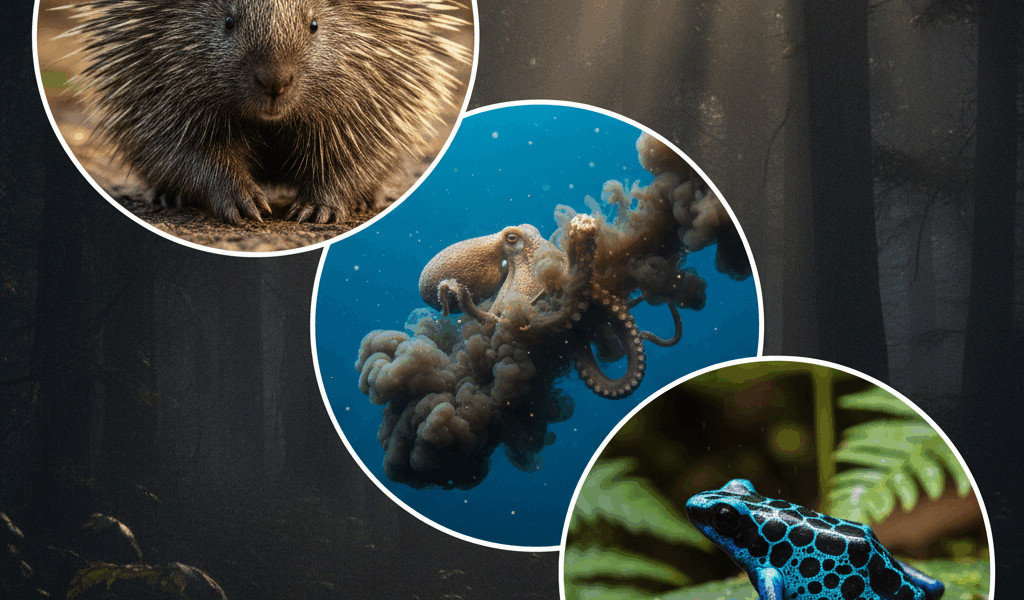
Poison dart frogs advertise their toxicity with brilliant colors. Their skin contains batrachotoxin, one of the most potent natural toxins known. A single golden poison dart frog carries enough poison to kill 10 adult humans.
**Animals that use this:** Poison dart frogs, monarch butterflies, coral snakes, and certain nudibranchs
### 7. **Mimicry – The Great Pretenders**
The harmless milk snake has evolved to look almost identical to the deadly coral snake. Predators that have learned to avoid coral snakes also avoid milk snakes, even though they’re completely harmless.
**Animals that use this:** Milk snakes, hover flies (mimic bees), viceroy butterflies (mimic monarchs), and certain caterpillars
### 8. **Reflex Bleeding (Autohaemorrhaging)**
Horned lizards can rupture blood vessels in their eyes and squirt blood up to five feet. The blood contains chemicals that are foul-tasting to canine and feline predators, making them drop the lizard immediately.
**Animals that use this:** Horned lizards and certain beetles
### 9. **Quills and Spines – The Porcupine Defense**
Porcupines have approximately 30,000 quills covering their body. Each quill has backward-facing barbs that make them extremely difficult and painful to remove. When embedded in a predator’s skin, they can work their way deeper with each movement.
**Animals that use this:** Porcupines, hedgehogs, echidnas, and pufferfish
### 10. **Alarm Calls – The Communication Network**
Prairie dogs have developed one of the most sophisticated alarm call systems in nature. They can communicate specific information about threats, including:
– Type of predator (hawk vs. coyote)
– Size of the threat
– Color of the threat
– Speed of approach
**Animals that use this:** Prairie dogs, meerkats, vervet monkeys, and many bird species
### 11. **Group Confusion – The Swarm Effect**
Schooling fish like sardines use coordinated movement to confuse predators. When thousands of fish move in perfect synchronization, it becomes nearly impossible for a predator to target a single individual. This phenomenon, called the “confusion effect,” reduces individual risk dramatically.
**Animals that use this:** Sardines, starlings (murmuration), wildebeest, and locusts
### 12. **Toxin Sequestration – Borrowed Poison**
Monarch butterfly caterpillars feed on toxic milkweed plants and store the toxins in their bodies. These toxins remain through metamorphosis, making the adult butterflies poisonous to birds. Once a bird vomits after eating a monarch, it remembers the distinctive orange and black pattern and avoids them forever.
**Animals that use this:** Monarch butterflies, sea slugs, certain beetles, and some frogs
### 13. **Speed and Agility – The Escape Artists**
The pronghorn antelope can run at speeds up to 60 mph and maintain 35 mph for several miles. This is actually faster than any predator in North America needs, leading scientists to believe they evolved this speed to escape now-extinct American cheetahs.
**Animals that use this:** Pronghorns, gazelles, jackrabbits, and kangaroos
### 14. **Burrowing – The Underground Escape**
When threatened, the pocket gopher can dig backwards nearly as fast as it can dig forwards. This allows it to escape predators by quickly reversing direction in its tunnel system. Some burrowing owls even mimic the sound of rattlesnakes in their burrows to deter predators.
**Animals that use this:** Pocket gophers, prairie dogs, rabbits, and burrowing owls
### 15. **Ink Clouds – The Smoke Screen**
Octopuses and squid can release clouds of dark ink when threatened. But this isn’t just a visual screen—the ink also contains chemicals that dull a predator’s sense of smell and taste. Some species can even shape the ink cloud into a decoy that resembles their own body, allowing them to escape while the predator attacks the phantom.
**Animals that use this:** Octopuses, squid, cuttlefish, and certain sea hares
## Why Do Prey Animals Need These Defenses?
The predator-prey relationship drives evolution. As predators become more efficient hunters, prey animals must develop better defenses to survive. This evolutionary arms race has been ongoing for hundreds of millions of years, resulting in the incredible diversity of defense mechanisms we see today.
## The Science Behind Prey Animal Defenses
### Energy vs. Risk Trade-offs
Every defense mechanism comes with costs:
– **Energy expenditure:** Growing quills or producing toxins requires resources
– **Opportunity costs:** Time spent watching for predators is time not spent eating
– **Physical limitations:** Heavy armor makes animals slower
Prey animals must balance these costs against the risk of predation. This is why you see different strategies in different environments and species.
### How Prey Animals Detect Threats
Most prey animals have eyes positioned on the sides of their heads, giving them nearly 270-degree vision. This wide field of view helps them spot predators approaching from almost any direction, though it comes at the cost of reduced depth perception.
Other specialized senses include:
– **Lateral lines in fish** – detect water movement from approaching predators
– **Whiskers in rodents** – sense vibrations and obstacles in darkness
– **Excellent hearing in rabbits** – large, mobile ears detect subtle sounds
– **Infrared sensing in some snakes** – detect warm-blooded predators
## Prey Animals and Ecosystem Balance
Prey animals aren’t just trying to survive—they play a crucial role in maintaining healthy ecosystems. Their defense mechanisms affect:
– **Predator populations:** Effective defenses keep predator numbers in check
– **Plant communities:** By avoiding predation, herbivore prey animals shape vegetation
– **Evolution:** The predator-prey arms race drives adaptation and speciation
## Conservation Implications
Understanding prey animal defenses is crucial for conservation efforts. When we protect habitats, we’re not just saving individual species—we’re preserving the complex relationships that allow these defense mechanisms to function effectively.
Many prey species are threatened by:
– Habitat loss (reducing escape routes and hiding places)
– Climate change (disrupting camouflage and seasonal adaptations)
– Invasive predators (that haven’t learned to recognize warning signals)
– Human activity (interfering with group behaviors and alarm systems)
## Conclusion: Nature’s Ingenious Solutions
Prey animals are far from helpless victims. They’re evolutionary success stories, having survived millions of years through ingenuity, adaptation, and remarkable defense mechanisms. From chemical weapons to psychological warfare, these animals prove that in nature, survival often depends on being smarter, not stronger.
The next time you see a rabbit, remember: you’re not looking at a defenseless creature, but at a sophisticated escape artist with senses, speed, and strategies honed by millions of years of evolution.
—
**Related Articles:**
– [10 Prey Animals That Keep Ecosystems in Balance](#)
– [How Predators Hunt Their Prey in the Wild](#)
– [Prey Animals In Crisis: Why Scientists Are Sounding The Alarm In 2026](#)
**Sources:**
– National Geographic: Animal Defense Mechanisms
– Journal of Animal Ecology: Predator-Prey Dynamics
– Smithsonian: Evolution of Animal Defenses
– Scientific American: Chemical Warfare in Nature


Leave a Reply