Extinction Has Always Happened — So What Changed
Animal extinction has gotten complicated with all the noise flying around about what’s actually causing it. When I first went down this rabbit hole, I expected something simple. Pollution. Overpopulation. Done. What I found instead was genuinely strange — extinction itself isn’t the problem. The speed is.
Earth’s baseline extinction rate — what researchers call the “background rate” — sits somewhere between one and five species per year. That’s the natural hum of biological turnover. Species emerge, species disappear through competition or shifting environments, and life reshuffles itself across geological time. That process has been running for over 3 billion years without much fanfare.
Then something broke.
Current extinction rates now hover between 100 and 1,000 species annually. Some estimates push higher depending on how you count undocumented insects and microorganisms — and most of us don’t count them at all. That’s not just faster than baseline. It’s 100 to 200 times faster. In practical terms: we’re losing species at mass-extinction velocity, except nobody declared a mass extinction. These are ordinary conditions, just run at the wrong speed.
The five prior mass extinctions — the Ordovician-Silurian, Late Devonian, Permian-Triassic, Triassic-Jurassic, and Cretaceous-Paleogene — killed off 75 to 96 percent of species. Those unfolded over millions of years. Asteroids. Volcanic winters. Ocean anoxia. What’s happening right now is occurring in a geological blink. Probably should have opened with this section, honestly, because the speed differential isn’t just a symptom. It’s the whole diagnosis.
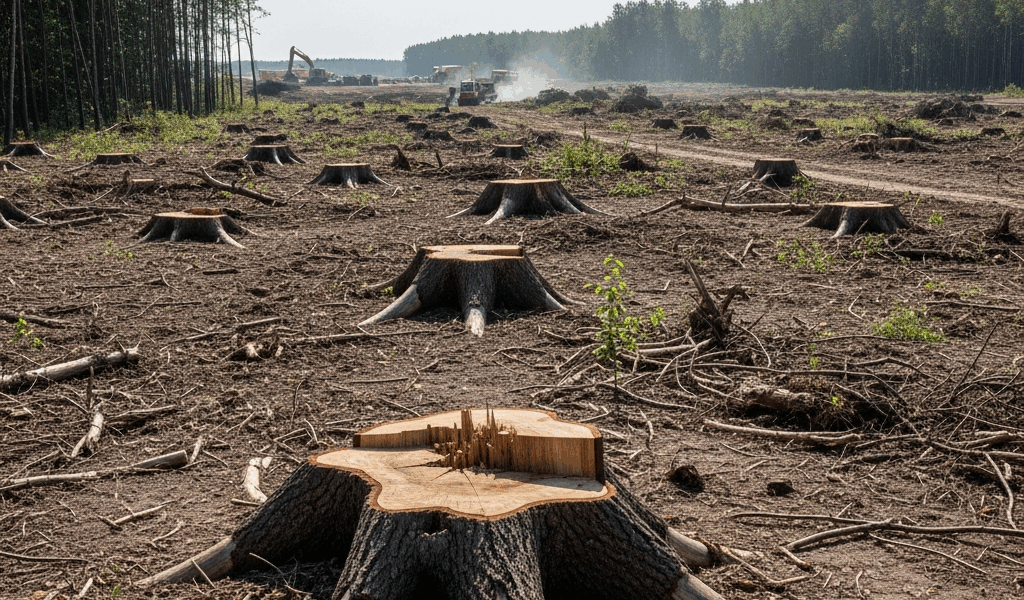
Habitat Loss Moves Faster Than Species Can Adapt
Evolution runs on one clock. Destruction runs on another. They stopped syncing a long time ago.
A species adapting to a new ecological niche might need thousands of generations. A bird developing resistance to a novel pathogen? Hundreds of years, minimum. A plant population adjusting its flowering window to match pollinator schedules takes decades of consistent pressure under stable conditions. None of this is fast. None of it tolerates interruption.
Take deforestation in the Brazilian Amazon between 2019 and 2022 — roughly 13,000 square kilometers cleared annually. That’s about 5,000 square miles per year. An Amazonian tree species with a 50-year lifespan would cycle through maybe three or four generations in that same window. Three generations to adapt to catastrophic habitat loss. The math doesn’t work.
But the deeper problem isn’t even total destruction. That’s just stage one.
Stage two is fragmentation — and it’s sneakier. Picture a forest the size of New Jersey. Loggers don’t clear it in one sweep. Roads cut through first. Then agricultural patches appear. What was one continuous ecosystem becomes ten isolated fragments, each surrounded by terrain hostile to movement. A jaguar population trapped in Patch Three can’t interbreed with the one in Patch Seven. Genetic diversity drops. Inbreeding depression sets in quietly. The population weakens from the inside, even when Patch Three’s canopy looks perfectly intact from the air.
Indonesian palm oil expansion since 1990 converted roughly 25 million hectares of forest to plantations. Orangutan populations fractured into isolated clusters. The largest groups lost 80 percent of individuals. Forest still existed on maps. The species was functionally gone from those regions anyway.
Species don’t need total annihilation to stop functioning. They just need to fall below the minimum viable population threshold — somewhere between 500 and 10,000 individuals depending on the species. Below that number, mathematics turns predatory. Genetic drift dominates. Useful alleles disappear randomly. Harmful ones spread. Within a few generations the population collapses, even in areas with abundant food and minimal predators. Don’t make my mistake of assuming visible habitat means a healthy population.
Invasive Species Act Like a Second Punch
A population already fractured by habitat loss doesn’t need much to tip it over. That’s where invasive species come in — not as a separate crisis, but as a compounding one.
The brown tree snake arrived in Guam around 1950, almost certainly via cargo shipments from the Admiralty Islands. Nobody flagged it. By the late 1980s, bird watchers started reporting something wrong. Forests that used to ring with calls went completely silent. The Guam rail. The Micronesian kingfisher. The Mariana crow. Most of the island’s native bird species vanished inside thirty years.
The brown tree snake isn’t particularly impressive. Medium-sized constrictor, maybe 6 to 8 feet at full growth. But Guam’s native birds evolved on an island with zero snakes. No predator-prey arms race had ever happened there. No defensive behaviors developed over generations. The birds didn’t fear snakes — they had no biological reason to. They nested in accessible spots. They flew low. To a brown tree snake, Guam was, effectively, an unguarded buffet.
That’s what makes evolutionary mismatch so devastating to island species specifically. Mainland animals live inside arms races — millions of years of co-evolution with predators and competitors. They arrive to new threats with a full toolkit. Island species often evolved without serious predators at all. They’re not naive. They’re just unarmed. Introduce a predator from somewhere that ran a different arms race, and you’re not adding a new stressor. You’re exposing a vulnerability that was never tested.
The brown tree snake eliminated most of Guam’s bird species before any coordinated response existed. That was the 1980s. The lesson still hasn’t fully landed elsewhere.
Climate Change Shifts the Goalposts Mid-Game
Here’s the part I genuinely didn’t expect when I started researching this: climate change mostly doesn’t kill species by making environments physically uninhabitable. It kills them by breaking the reliability of environmental cues.
Every species evolved in sync with its local calendar. Migratory birds time their arrival by day length — that cue is rock solid, has been for millennia. The insects those birds depend on for feeding chicks emerge based on spring temperatures hitting specific thresholds. Also reliable. Or it was.
Temperature thresholds are being crossed earlier now. Birds still follow the day-length cue because light hasn’t changed. They arrive on schedule. Peak insect emergence is already ending. The chicks hatch into a window where food density is dropping fast. Breeding success falls. Populations decline — not from habitat loss, not from predators. From a calendar that no longer matches.
Coral reefs run the same problem at a different scale. Corals tolerate temperature swings within a narrow band — maybe 1 to 2 degrees Celsius above their seasonal average before they expel symbiotic algae and bleach. Historically, bleaching events came roughly every 50 to 100 years. The water cooled. The relationship with symbiotic algae rebuilt. Recovery happened. Now major bleaching events arrive every 5 to 10 years on reefs like the Great Barrier Reef. There’s no recovery window between events. The next heat spike arrives before the last one has healed.
The environment these species evolved for hasn’t disappeared. It’s become unpredictable. That unpredictability is what kills species with inflexible lifecycles — not fire, not chainsaw, just a broken promise from the climate they were built around.
What the Current Acceleration Actually Means Going Forward
These four pressures — habitat loss, fragmentation, invasive species, climate timing failure — don’t line up neatly as separate problems. They stack.
A population already weakened by fragmentation carries fewer genetic tools when an invasive predator shows up. That same population, struggling to maintain numbers, can’t absorb behavioral disruption when phenological cues stop lining up with food availability. Each stressor lowers the threshold for the next one. The cascade accelerates because the buffers are already gone.
That’s what the speed differential actually means in practice. We’re not just losing species. We’re losing them faster than recovery mechanisms activate. Faster than evolution can respond. Faster than conservation infrastructure can mobilize.
I’m apparently someone who assumes decline is linear and permanent — and that assumption was wrong. American bison recovered from roughly 300 individuals in 1890 to over 20,000 today. Bald eagles came back from near-elimination in the continental U.S. after DDT bans in 1972. Arabian oryx were extinct in the wild by 1972, then reintroduced through captive breeding programs starting in the 1980s. Some Arabian coral populations are showing heat-tolerance genetics that restoration teams can now specifically target. The science on that is new — roughly 2018 onward.
These aren’t feel-good footnotes. They’re proof that the acceleration can be interrupted — when the response is scaled proportionally to the actual rate of loss.
The question isn’t whether extinction is accelerating. We have that data. It is. The question is whether conservation response can outrun the extinction rate itself. Right now, it isn’t. But the gap isn’t fixed. That’s what makes it worth closing.


Leave a Reply