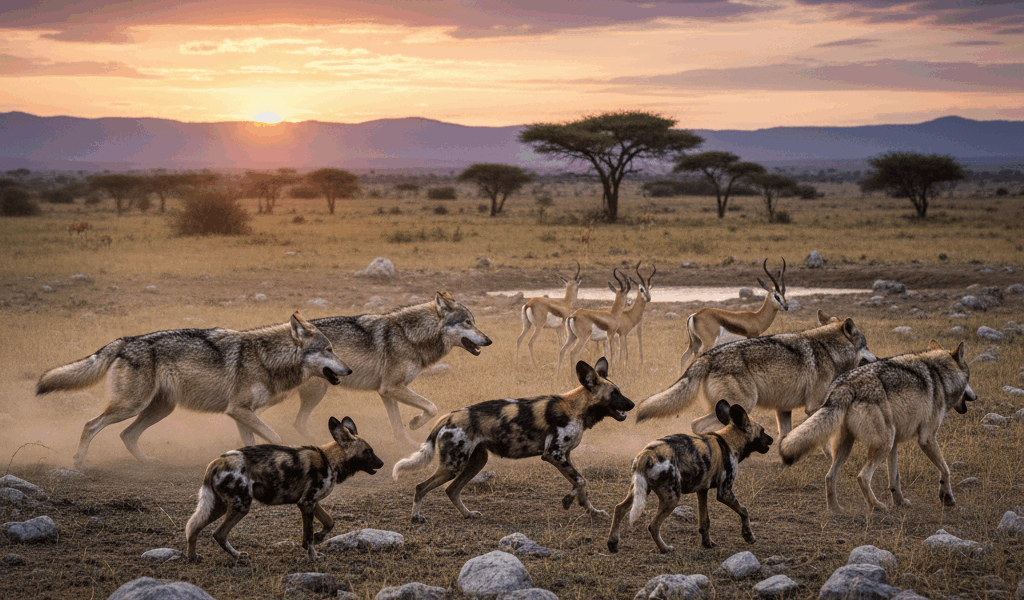
Few animals capture human imagination quite like wolves and their wild relatives. From the haunting howl of gray wolves echoing across northern forests to the synchronized hunts of African wild dogs on the savanna, these pack hunters represent some of nature’s most sophisticated social predators. Their complex family structures, remarkable communication systems, and cooperative hunting strategies have evolved over millions of years, creating species perfectly adapted to pursue prey across diverse landscapes on every continent except Antarctica.
The family Canidae encompasses approximately 35 species of wolves, dogs, foxes, and jackals, but it is the pack-hunting members that truly demonstrate the evolutionary advantages of social cooperation. Understanding these remarkable predators reveals not only the intricacies of carnivore ecology but also provides crucial insights for conservation efforts aimed at protecting these often-misunderstood animals.

The Gray Wolf and Its Remarkable Subspecies
The gray wolf (Canis lupus) stands as the largest wild member of the dog family and one of the most widely distributed land mammals in history. Once ranging across virtually the entire Northern Hemisphere, gray wolves have demonstrated remarkable adaptability to environments from Arctic tundra to Arabian deserts. Scientists recognize numerous subspecies, each adapted to specific regional conditions and prey bases.
The Arctic wolf (Canis lupus arctos) inhabits the Canadian Arctic Archipelago and northern Greenland, surviving in one of Earth’s harshest environments. These wolves typically display pure white or cream-colored coats that provide camouflage against snow and ice while hunting muskoxen and Arctic hares. Their smaller ears and shorter muzzles reduce heat loss in extreme cold, demonstrating classic adaptations to polar climates.
The Northwestern wolf (Canis lupus occidentalis), also known as the Mackenzie Valley wolf, represents one of the largest subspecies. Males can exceed 140 pounds, making them formidable predators capable of taking down adult moose and bison. These wolves were instrumental in the famous Yellowstone reintroduction program, bringing their hunting prowess to an ecosystem that had lost its apex predator decades earlier.
The Mexican wolf (Canis lupus baileyi) tells a different story. Once ranging throughout the American Southwest and into central Mexico, this subspecies was driven to the brink of extinction by the 1970s. Only a handful of captive individuals remained when recovery efforts began, making the Mexican wolf’s survival one of conservation’s most challenging projects.
European wolves (Canis lupus lupus) have shown remarkable resilience across their range. After centuries of persecution that eliminated them from much of Western Europe, populations have been expanding since the late 20th century. Wolves now inhabit portions of Germany, France, and even the Netherlands, demonstrating that coexistence between wolves and dense human populations is possible with proper management.
The Endangered Red Wolf
The red wolf (Canis rufus) holds the unfortunate distinction of being one of the world’s most endangered canids. Native to the southeastern United States, this medium-sized wolf was declared extinct in the wild in 1980 before a captive breeding program enabled limited reintroduction to northeastern North Carolina beginning in 1987.
Red wolves occupy an interesting taxonomic position that scientists continue to debate. Some researchers consider them a distinct species that evolved in North America, while others suggest they represent a historical hybrid between gray wolves and coyotes. Regardless of their exact classification, red wolves exhibit unique characteristics, including their reddish-brown coloring, narrower muzzle, and proportionally larger ears compared to gray wolves.
The current wild population fluctuates between 15 and 25 individuals, making recovery efforts precarious. Hybridization with expanding coyote populations poses a significant threat, as does continued conflict with some local landowners. The Red Wolf Recovery Program employs innovative strategies including coyote sterilization within red wolf territories to prevent hybridization while maintaining coyote territorial behavior that excludes other coyotes.
African Wild Dogs and the Art of Cooperative Hunting
African wild dogs (Lycaon pictus) represent perhaps the most social of all canids and certainly the most efficient hunters. With hunting success rates approaching 80%, far exceeding lions at roughly 25%, these painted wolves have perfected the art of cooperative predation. Their mottled coats of brown, black, and white provide each individual with a unique pattern, allowing researchers to identify specific animals from photographs.
Pack dynamics among African wild dogs differ from wolves in several key ways. Rather than a strict dominance hierarchy, wild dog packs function more democratically. Hunting decisions appear to follow a voting system where pack members sneeze to indicate their readiness to move. When enough sneezes accumulate, the pack initiates the hunt, with more dominant individuals requiring fewer votes than subordinate members.
African wild dogs once ranged across most of sub-Saharan Africa but have been reduced to perhaps 6,000 individuals in fragmented populations. Their need for large territories, conflict with livestock farmers, and susceptibility to diseases from domestic dogs have all contributed to their decline. However, several strongholds remain, including northern Botswana, Zimbabwe, Tanzania, and Zambia.
The Painted Dog Conservation project and similar organizations work to protect remaining populations through anti-snaring patrols, conflict mitigation with farmers, and educational programs that help local communities understand the ecological importance of these remarkable hunters.
Dingoes as Living Links to Ancient Dogs
Australia’s dingo (Canis lupus dingo or Canis dingo, depending on classification) arrived on the continent approximately 4,000 years ago, likely brought by seafaring peoples from Southeast Asia. Since then, dingoes have become integral to Australian ecosystems, functioning as apex predators that help control populations of kangaroos, wallabies, and introduced species like rabbits and foxes.
Pure dingoes display sandy to reddish-brown coats, erect ears, and bushy tails. They typically form family groups rather than large packs, though groups may cooperate when hunting larger prey. Unlike domestic dogs, dingoes breed only once per year and exhibit several other behavioral traits that distinguish them from their domesticated relatives.
Conservation of pure dingoes faces an unusual challenge. Hybridization with domestic and feral dogs threatens genetic integrity across much of their range. Some researchers estimate that truly pure dingoes may only persist on Fraser Island and in remote areas of the Tanami Desert. The Dingo Discovery Sanctuary and Research Centre works to maintain genetically pure populations while educating the public about dingo ecology and conservation.
Pack Dynamics and the Evolution of Cooperation

The evolution of pack hunting among canids represents one of nature’s most successful cooperative strategies. Pack living provides numerous advantages beyond hunting efficiency, including territory defense, pup rearing, and thermoregulation in cold climates. The complex social bonds that develop within packs rival those of primates in sophistication.
Wolf packs typically consist of a breeding pair and their offspring from multiple years. The term “alpha” has fallen out of favor among researchers who now recognize that wolf packs function as families rather than dominance hierarchies maintained through aggression. Parents naturally lead, and offspring defer to them as they would in any family structure.
Communication within packs involves an intricate combination of vocalizations, body language, and scent marking. The famous wolf howl serves multiple functions, including pack assembly, territory advertisement, and social bonding. Each wolf’s howl is individually distinctive, allowing pack members to identify each other across great distances.
Cooperative hunting enables pack hunters to tackle prey far larger than any individual could subdue alone. Gray wolves routinely hunt elk and moose weighing ten times their body weight, while African wild dogs can pursue and exhaust prey through relay chasing over several miles. This ability to access large prey items provides caloric returns that offset the costs of sharing food within the group.
Wolf Reintroduction and Ecosystem Recovery
The reintroduction of gray wolves to Yellowstone National Park in 1995-1996 has become the world’s most studied and celebrated rewilding success. After 70 years of absence, 31 wolves from Canada were released into the park, initiating a cascade of ecological changes that transformed the landscape.
Researchers documented what they termed a “trophic cascade,” where the return of apex predators influenced species and even physical features throughout the ecosystem. Elk changed their behavior, avoiding areas where they were vulnerable to wolf predation. This behavioral shift allowed willows and aspens to regenerate along streams, which in turn provided habitat for songbirds and beavers.
Beaver populations increased, and their dams created new wetland habitats for fish, amphibians, and waterfowl. Scavengers from ravens to grizzly bears benefited from wolf kills. Even stream courses changed as vegetation stabilized banks that had eroded during the elk-dominated decades. While some claims about Yellowstone’s recovery have been oversimplified, the general pattern demonstrates how apex predators shape ecosystems far beyond their direct prey.
Similar reintroduction programs in Idaho, the northern Rocky Mountains, and proposed efforts in Colorado aim to restore ecological balance while managing inevitable conflicts with livestock operations. Compensation programs for verified livestock losses and non-lethal deterrence methods help build tolerance among ranching communities.
Coyotes and Jackals as Adaptable Generalists
While wolves and wild dogs specialize in pack hunting of large prey, their smaller relatives have pursued different evolutionary strategies. Coyotes (Canis latrans) demonstrate perhaps the most remarkable adaptability of any North American carnivore. Despite more than a century of intensive persecution, coyotes have expanded their range from the prairies to now inhabit virtually every habitat type from Alaska to Panama, including major urban centers.
Coyote success stems from their dietary flexibility and behavioral plasticity. They hunt alone, in pairs, or in loose packs depending on prey availability. Urban coyotes have learned to exploit human food sources while avoiding human activity patterns. Their smaller size compared to wolves allows them to survive on prey as small as insects and berries during lean times.
Jackals fill similar niches across Africa and southern Asia. The golden jackal (Canis aureus) has been expanding its range into Europe, with established populations now in the Balkans and sightings as far west as France. Black-backed and side-striped jackals remain primarily African, occupying savannas and woodlands where they hunt small prey and scavenge larger carcasses.
Conservation Challenges and Future Prospects
Conserving wolves and wild dogs requires addressing a complex web of ecological, social, and political factors. Human-wildlife conflict remains the primary threat to most species, whether through direct persecution, habitat loss, or disease transmission from domestic animals. Building tolerance among communities that live alongside these predators is essential for long-term conservation success.
Protected areas alone cannot sustain viable wolf and wild dog populations. These wide-ranging predators require landscape-level conservation that incorporates private lands, wildlife corridors, and cross-border cooperation. The Y2Y (Yellowstone to Yukon) initiative in North America and similar transboundary efforts in Europe and Africa recognize that effective carnivore conservation must transcend political boundaries.
Climate change introduces additional uncertainties. Shifting prey distributions, altered habitat conditions, and increased disease transmission may all impact canid populations in coming decades. Arctic wolves face particular vulnerability as warming temperatures transform tundra ecosystems. Conversely, some populations may benefit from extended snow-free seasons that improve hunting conditions.
The future of wolves and wild dogs depends largely on human willingness to share landscapes with these remarkable predators. Education programs that emphasize ecological benefits, economic opportunities through wildlife tourism, and effective conflict mitigation all contribute to building the social acceptance necessary for coexistence. As apex predators, wolves and wild dogs help maintain healthy ecosystems that benefit countless other species, including humans who depend on the ecological services these systems provide.
From the frozen Arctic to African grasslands, pack hunters continue to demonstrate the power of cooperation in nature. Their survival in the 21st century will reflect our own capacity to cooperate across communities, cultures, and borders in service of preserving Earth’s biological heritage.




Leave a Reply