How Fast Is Borneo Losing Forest Habitat
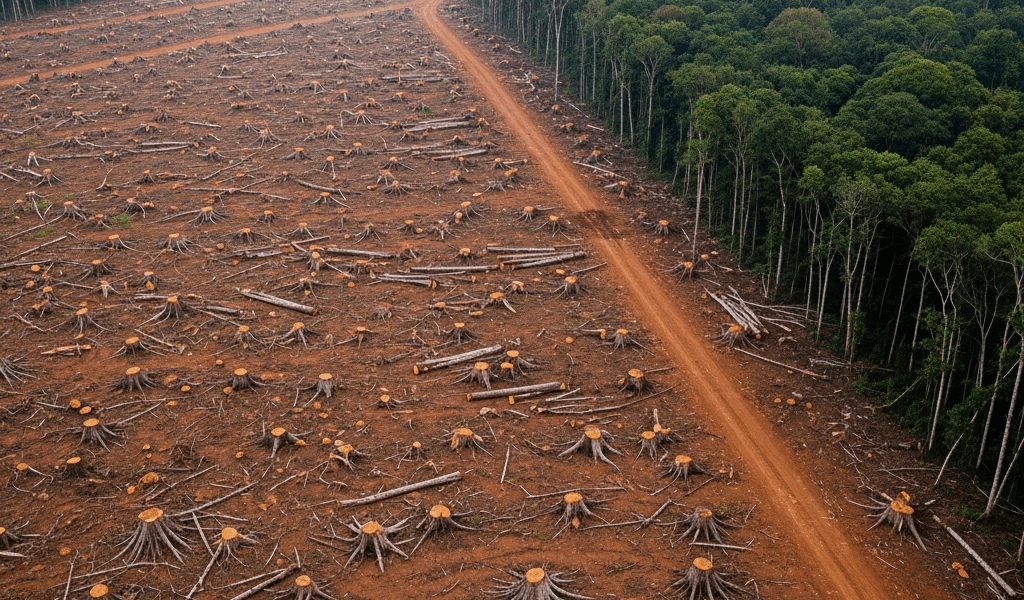
Orangutan habitats in Borneo are shrinking at a pace that honestly caught me off guard when I started digging into the satellite data. Between 2000 and 2020, Borneo lost approximately 6.14 million hectares of forest. That’s roughly the size of West Virginia gone in two decades.
But here’s what matters more—the acceleration itself. From 1973 to 2000, deforestation averaged around 200,000 hectares annually. After 2000? That number jumped to 307,500 hectares per year through 2020. We’re not just cutting faster. We’re cutting dramatically faster in the exact period when orangutan populations became most vulnerable.
Indonesia controls roughly 75% of Borneo, with Malaysia holding Sabah and Sarawak. USGS Landsat satellite imagery shows the Indonesian side experiencing the steepest declines. By 2020, only about 50% of Borneo’s original forest cover remained—not a projection or estimate, confirmed measurements from repeated satellite passes over twenty years.
Speed compounds the problem in ways selective logging never did. An orangutan population needs contiguous forest stretching across dozens of kilometers. Slow harvesting leaves the canopy structurally intact even as certain trees disappear. Fast industrial conversion leaves nothing behind. When deforestation hits 300,000-plus hectares yearly, habitat fragmentation accelerates beyond what the species can adapt to.
Why Palm Oil Drives Habitat Loss Faster Than Other Industries
Selective logging used to be Borneo’s primary driver of forest degradation. A logging operation might remove high-value timber like meranti or kapur over several years, leaving the forest standing and damaged but functional for wildlife. Then palm oil changed the equation entirely.
Companies like Wilmar International, Golden Agri-Resources, and Cargill hold massive concessions across Indonesian Borneo. A single Wilmar concession in Kalimantan spans roughly 800,000 hectares — that’s the entire footprint of Yellowstone National Park worth of land dedicated to one crop for one corporation.
The economic reality explains everything. A sustainable tropical timber operation might generate $500-800 per hectare annually. Oil palm generates $2,000-3,500 per hectare in the first profitable years, sometimes higher. That profit margin difference justifies the capital investment in complete habitat conversion. It’s not complicated once you see the numbers.
Selective logging requires leaving trees standing. Palm cultivation requires clear-cutting everything—every tree, every shrub, every root system removed. Then workers plant genetically identical palms in neat rows. The entire process transforms forest to monoculture in 18-24 months instead of years of selective harvesting.
Scale accelerates this even further. A logging company operating in one concession might remove timber from 50,000 hectares over a decade. A palm oil operator clears 50,000 hectares in a single year across multiple concessions. Borneo’s major palm oil players collectively control over 4 million hectares of concessions. When even half of those see active conversion, you’re looking at deforestation rates that dwarf previous industrial activity.
Probably should have opened with this section, honestly. The economic incentive is the actual mechanism driving habitat loss, not some abstract environmental pressure.
The Gap Between Protected Land and Actual Protection
Indonesia and Malaysia have established extensive protected area networks. Sabah alone designates over 1.4 million hectares as protected forest. Sarawak protects roughly 1.7 million hectares. Kalimantan’s protected areas total approximately 7 million hectares across various reserve categories.
Protected designation changes almost nothing. Satellite imagery shows deforestation continuing inside official reserves at rates sometimes matching unprotected areas. That’s the central problem.
Enforcement capacity is where habitat actually disappears. A reserve in Sabah requires rangers to patrol thousands of square kilometers with minimal funding, equipment, or legal backing when concession holders claim overlapping rights. Illegal logging operates openly in reserves like Ulu Segam and Maliau Basin because enforcement simply doesn’t exist at the scale required.
Land claim conflicts compound everything. A concession holder might possess a government-issued permit for an area nominally protected as an indigenous reserve or national park. Multiple governments have issued overlapping permits to different companies for identical land. When disputes reach court, proceedings stretch across years while operators clear forest and claim possession through occupation.
Corruption makes this systematic rather than occasional. Officials approving concessions in protected areas might receive payments of $5,000-50,000 per permit depending on concession size. An operator spending that amount recovers the investment within weeks of beginning palm oil cultivation. The math incentivizes continued permit approval.
Sarawak’s experience illustrates this clearly. The state nominally protects around 1.7 million hectares but has issued timber and oil palm concessions covering over 2.5 million hectares. The overlap is not accidental—it’s structural by design. Companies operate knowing that legal challenges will take years to resolve, giving them time to clear profitable timber and plant palms before any enforcement action occurs.
What Happens to Orangutans When Forest Disappears
Population decline is the metric everyone cites. Borneo’s orangutan numbers dropped from roughly 288,500 individuals in 1950 to approximately 45,000-69,000 today. Those figures come from repeated survey work documented across decades of research.
The mechanism connecting population collapse to habitat loss speed is direct. Orangutans require large home ranges—males need 15-60 square kilometers of continuous forest depending on fruit availability and population density. When deforestation fragments habitat, individuals become isolated in forest patches too small to sustain breeding populations.
Fragmented populations experience reproductive collapse. A patch of forest supporting 200 orangutans might contain only 15-20 breeding females. When individuals die, genetic diversity crashes. Birth rates drop as remaining individuals face inbreeding depression and skewed sex ratios.
Behavioral shifts precede population crashes by years. Researchers tracking orangutans in East Kalimantan documented increased aggression and territorial conflict after 2008 as deforestation contracted forest area by roughly 2,500 hectares yearly in their study area. Animals that previously occupied non-overlapping ranges began competing for the same remaining forest blocks.
Human-wildlife conflict incidents spike when habitat shrinks. Orangutans seeking food enter agricultural areas bordering forest remnants. Farmers kill individuals raiding crops. In Sabah, human-orangutan conflict incidents jumped from approximately 30 reported cases annually in 2005 to 200+ cases by 2015, correlating directly with forest cover loss in plantation-adjacent landscapes.
Reproductive success measurably declines. Female orangutans give birth approximately every 6-7 years under normal conditions. In fragmented populations, birth intervals extend to 8-9 years or longer as females’ nutritional stress increases and infant survival rates drop. A population of 100 females might produce 14-15 offspring annually under normal conditions but only 8-10 in fragmented habitat.
Can Reforestation Efforts Keep Pace With Deforestation
The numbers tell a blunt story. Borneo loses approximately 300,000-350,000 hectares yearly. Reforestation efforts across all organizations combined replant roughly 15,000-20,000 hectares annually. The deficit is a 15:1 or 20:1 ratio favoring loss.
Organizations like Borneo Orangutan Survival (BOS) and HUTAN Foundation operate some of the largest restoration programs. BOS manages reforestation across approximately 23,000 hectares in Kalimantan as of 2023. HUTAN works in Sabah and Sarawak with similar scope. These initiatives are genuine conservation efforts, but 23,000 hectares represents roughly two months of Borneo’s deforestation rate.
Replanted forest functions differently than primary forest for years or decades. A newly established palm oil plantation cleared in 2010 might be reforested beginning in 2025—most conversions show no restoration whatsoever. That 15-year gap means a generation of orangutans loses habitat with zero replacement. When reforestation does occur, young plantation forests lack the structural complexity and fruit diversity that orangutans require for survival.
Replanted forests become functional orangutan habitat gradually—typically requiring 30-50 years of growth before fruit availability and canopy structure approach primary forest conditions. Borneo cannot wait 30-50 years. Current reforestation timelines suggest restoring habitat lost in the 2000s might take until 2050 or beyond, while primary forest continues disappearing at its current pace.
Economic incentives work against reforestation at scale. Governments profit more from issuing new concessions than managing reforestation projects. Companies profit more from continued cultivation than abandoning plantations for restoration. Reforestation projects depend on NGO funding and carbon credits, revenue streams worth $5-15 per hectare compared to palm oil’s $2,000+ per hectare.
The honest assessment: reforestation cannot match deforestation. Habitat loss will continue accelerating unless primary deforestation stops. Current restoration efforts prevent some population collapse but cannot reverse it. Without stopping new forest conversion immediately, orangutan populations on Borneo face continued decline regardless of reforestation success.



Leave a Reply