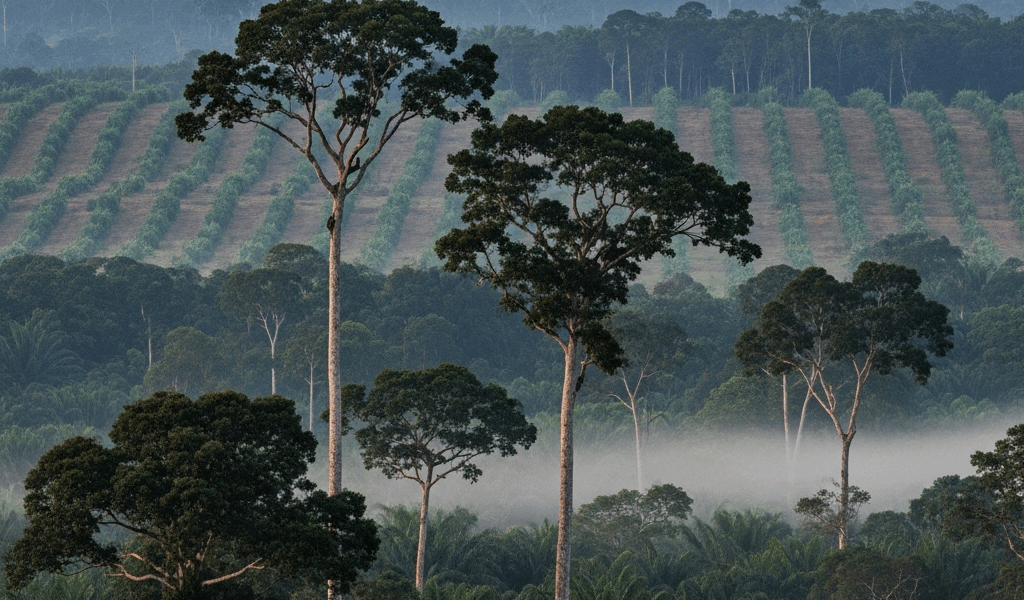
How Many Orangutans Are Actually Left Right Now
Orangutan conservation has gotten complicated with all the conflicting numbers and optimistic press releases flying around. So let me just tell you what we’re actually working with. Bornean orangutans — roughly 100,000 individuals scattered across fragmented forest patches. Sumatran orangutans — fewer than 14,000. The Tapanuli subspecies, which researchers only formally identified in 2017, sits under 800 animals in a single forest block in North Sumatra.
Those numbers sound almost fine until you know the context. “100,000 Bornean orangutans” sounds stable. It isn’t. Fifty years ago, Borneo held over 300,000. Sumatra had around 230,000. Do the math on that decline and sit with it for a second.
But what is the real problem here? In essence, it’s distribution. But it’s much more than that. Those 100,000 Bornean orangutans don’t exist as one coherent population — they’re isolated in pockets, some reserves holding fewer than 500 animals. Populations that small experience inbreeding depression, gutted genetic diversity, and serious vulnerability to disease. A single wildfire in one forest block can eliminate 5 percent of the entire subspecies. Not theoretical. In 2015, fires destroyed habitat housing thousands of Bornean orangutans. Gone.
Population density matters more than raw headcount. Habitat fragmentation means you don’t have 100,000 stable animals. You have dozens of disconnected sub-populations — many of them genuinely unable to sustain themselves long-term without outside intervention.
How Palm Oil Expansion Fragments Orangutan Habitat
Deforestation isn’t the only problem — it’s the specific pattern of deforestation that crushes orangutan populations. Clear-cut a forest for palm oil and you don’t just lose trees. You create isolation. That’s what makes this particular threat so devastating to orangutans specifically — they can’t cross industrial monoculture the way some species might adapt to fragmented landscapes.
Malaysia and Indonesia control roughly 85 percent of global palm oil production. Borneo alone produces around 5.5 million metric tons annually across Sabah, Sarawak, and East Kalimantan. Sumatra contributes another 6 million metric tons, concentrated in North Sumatra, Riau, and Jambi provinces. Orangutans won’t move through palm plantations. They simply won’t. So any forest block on the other side of that plantation becomes genetically and reproductively cut off.
RSPO certification — the Roundtable on Sustainable Palm Oil — exists as a credentialing system for lower-impact practices. But here’s what the data actually shows: certified plantations still clear habitat, still expand into forest margins, still leave orangutans trapped in shrinking reserves. Enforcement is the actual story, not the certification itself. Where government oversight is weak, compliance becomes selective at best.
The mechanism is straightforward and ugly. Plantation companies identify forest blocks with timber value. Local governments approve the concessions. Companies log selectively first — making the remaining forest attractive to further development. Within three to five years, that same block is cleared entirely for palm. Orangutans depending on that corridor lose access to food resources, breeding populations, and any genetic exchange with neighboring groups.
Probably should have opened with this section, honestly — because Indonesia’s moratorium on new forest-clearing licenses, implemented back in 2011, sounds genuinely protective until you look at enforcement. Satellite data from the past several years shows significant clearing continuing inside moratorium boundaries. Secondary logging, local land conversion, permits issued under different legal classifications — all of it circumventing official policy while the paperwork looks clean.
Why Illegal Logging and Mining Keep Accelerating the Loss
Protected areas across Borneo and Sumatra face enforcement gaps that make “protection” largely theoretical on the ground. Central Kalimantan province — home to Tanjung Puting National Park — houses roughly 7,000 wild orangutans. Satellite monitoring has documented illegal logging inside those park boundaries every single year for the past decade. Every year.
Mining compounds everything. Coal operations in East Kalimantan, gold extraction in Riau, tin mining across Bangka Island — all of it requires road infrastructure. Roads create poacher access. They also fragment habitat at landscape scale. And here’s the thing people miss: a 12-meter-wide mining access road doesn’t just clear 12 meters of forest. It opens the entire surrounding area to encroachment, settlement, and agricultural expansion.
East Kalimantan’s Kutai National Park employs approximately 60 rangers across 200,000 hectares. That’s one ranger per 3,300 hectares. I’m apparently not a wildlife ranger, and even I know one person cannot meaningfully monitor multiple square kilometers of dense tropical forest. Illegal activity continues because detection is genuinely unlikely. Don’t make my mistake of assuming “national park” means actively defended space.
Researchers analyzing satellite data from 2000 to 2020 found that every kilometer of new road cut through orangutan habitat correlated with roughly 0.8 percent habitat loss within a 5-kilometer buffer zone. Roads don’t just pass through wilderness — they trigger cascades of settlement, agriculture, and resource extraction that spread outward for years.
What Role the Illegal Pet Trade Plays in Population Decline
As someone who has spent time looking into wildlife trafficking networks, I learned everything there is to know about how brutally simple the economics are. Today, I will share it all with you — and none of it is pleasant.
Infants are what buyers want. An orangutan infant on the black market sells for $5,000 to $27,000 depending on subspecies and the buyer’s location. Getting that infant alive means killing the mother first — orangutans don’t abandon nursing young willingly. Each confiscated infant represents at minimum one dead mother. Often two, when a secondary adult is present and attempting to protect the infant.
Wildlife trade estimates suggest for every animal reaching the market, two to five additional animals die during capture, transport, or pre-sale captivity. Between 2016 and 2023, rescue organizations recovered approximately 700 young orangutans across Borneo and Sumatra — most from private homes, purchased illegally through online networks.
Rehabilitation success runs around 50 to 60 percent. That sounds reasonable until you look underneath the number. An orphaned infant raised in human captivity learns no foraging behavior from a mother. Develops no appropriate fear of humans. Has reduced capacity to navigate the social hierarchies of wild populations. Even animals successfully released face higher mortality than wild-born juveniles. The pet trade doesn’t just shrink wild populations through capture — it degrades the quality of animals available to replenish them.
Which Conservation Efforts Are Actually Moving the Needle
So, without further ado, let’s dive into what’s actually working — and what “working” honestly means in this context.
The Borneo Orangutan Survival Foundation manages roughly 70,000 hectares across multiple provinces. Their data shows habitat loss inside conservation zones dropped from 8 percent annually to 2.1 percent after establishing competitive-salary ranger patrols and community monitoring networks. Real slowdown — not a reversal, but real. The population inside their focus areas holds at roughly 12,000 animals, stable only through continuous active intervention.
The Sumatran Orangutan Conservation Programme shows comparable results in Sumatra — annual population losses dropping from 4.2 percent to 1.8 percent over a decade. Slowed. Not stopped. That distinction matters enormously.
What these programs share is actual enforcement — rangers paid competitive wages, equipped properly, patrolling regularly. Communities in surrounding areas receive economic incentives directly tied to conservation outcomes. Some villages in Borneo now earn income through eco-tourism and carbon credit programs linked to protected forest. That’s what makes community buy-in endearing to us as a conservation model — it aligns economic reality with forest survival rather than fighting against it.
While you won’t need to single-handedly reform Indonesian forestry policy, you will need a handful of hard truths. No conservation program has expanded wild orangutan populations. None. The best outcomes show stabilization in small areas under intensive management. Landscape-level population recovery hasn’t happened anywhere yet.
Researchers focused on long-term recovery emphasize three requirements — enforcement expanding beyond boutique protected zones to landscape-level implementation across concessions and settlements; palm oil expansion ceasing to enter habitat corridors entirely, not slowing but stopping; and illegal trade networks facing international prosecution targeting suppliers and buyers, not just rescue operations pulling infants from living rooms.
Current efforts slow decline. That’s the honest summary. They don’t reverse it.




Leave a Reply