How Many Jaguars Are Actually Left
Jaguar conservation has gotten complicated with all the conflicting numbers flying around. Somewhere between 64,000 and 173,000 jaguars still roam the Western Hemisphere — and yes, that gap is enormous. More than threefold. But it isn’t sloppy science. Counting an apex predator that ranges across 11 countries, hunts inside dense rainforest, and genuinely wants nothing to do with humans is brutally hard. Camera traps miss cats. Scat surveys miss territory. The math gets messy fast.
The IUCN currently lists jaguars as “Near Threatened.” Sounds almost fine, right? It isn’t. Researchers who’ve spent years on the ground — tracking scat, reviewing trap footage at 2 a.m. — will tell you that classification is running about a decade behind actual field conditions. Even the optimistic end of those population estimates represents a staggering contraction. Five hundred years ago, jaguars ranged from Arizona down to Patagonia. Today, that range has been cut roughly in half. The pessimistic read of the data suggests we’ve already lost more than we’ve managed to keep.
What makes this especially urgent is biology. A solitary male jaguar needs somewhere between 25 and 150 square kilometers of territory depending on how much prey is available. When populations fragment below certain thresholds, genetic diversity starts collapsing. Inbreeding becomes inevitable. A smaller population isn’t just numerically smaller — it’s measurably weaker, generation by generation.
Why Deforestation Cuts More Than Just Trees
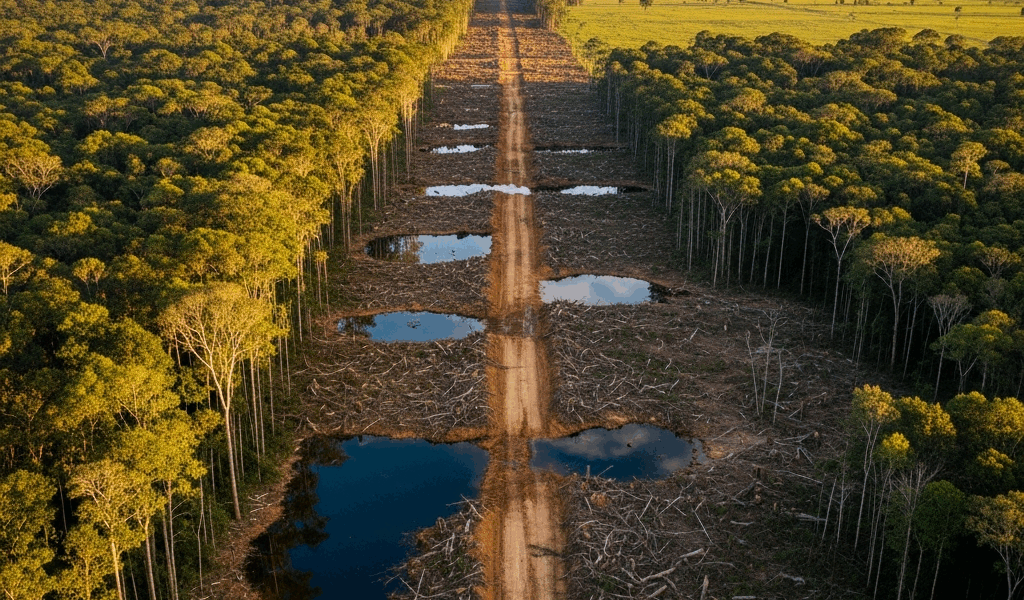
Habitat fragmentation is the single biggest driver of jaguar decline. But what is fragmentation, exactly? In essence, it’s what happens when continuous forest gets chopped into isolated patches. But it’s much more than that — it’s a slow biological trap that locks animals into shrinking islands with no safe way out.
The Amazon has lost roughly 17 percent of its forest cover over the last 50 years. The Gran Chaco — a vast lowland spreading across Bolivia, Paraguay, and Argentina — has been cleared at jaw-dropping speed, accelerating sharply after 2000. Those are the headline numbers. Here’s the part most jaguar articles skip entirely.
When forest becomes a patchwork, a female jaguar in one patch can’t safely reach a male five kilometers away. She has to cross cattle ranches, soy fields, human settlements. That crossing gets her killed. Isolated populations shrink. Birth rates stop keeping pace with mortality. Genetic variation within each surviving pocket declines by roughly 1 to 3 percent per generation — compounding. That’s not a metaphor. That’s a documented biological measurement.
Fragmentation also starves jaguars by destroying prey populations first. Capybaras, peccaries, caimans, deer — all of them need connected territory too. Chop forest into pieces and prey collapses faster than jaguars can adapt their hunting behavior. A jaguar working a small patch burns more energy than it recovers. Some turn to cattle. Most just disappear.
In the Amazon, cattle ranching is the primary engine of destruction — expanding at roughly 100,000 square kilometers per decade in some Brazilian states. In the Gran Chaco, soy cultivation for export markets has cleared forest at rates exceeding 300,000 hectares annually in recent years. These aren’t projected threats. They’re documented, quantified, accelerating losses happening right now.
The Rancher Conflict That Never Got Solved
Probably should have opened with this section, honestly. You can’t understand why jaguar numbers are falling without understanding why ranchers shoot them — not as cartoon villains, but as people making rational economic decisions inside a system that gives them almost no other options.
A jaguar taking cattle is genuinely costly. Livestock losses attributed to big cats across Brazil, Bolivia, and Paraguay run into millions of dollars annually. When a jaguar kills three or four head of cattle in a single week, that’s not an abstract wildlife statistic. That’s a family’s primary income. In rural areas where alternative livelihoods barely exist, a cattle herd is everything. The anger is real. The economic logic is real.
Here’s the problem: livestock losses get wildly overstated. Studies comparing rancher-reported predation to verified jaguar kills reveal a stubborn gap. Disease, theft, and feral dogs account for more cattle loss than felids do in most regions — but jaguars take the blame. Armed and frustrated, ranchers kill them anyway. Retaliatory killing happens fast, happens in legally protected areas, and happens to nursing females. Don’t make my mistake of assuming legal protections translate to actual protection on the ground. They often don’t.
Compensation programs exist — payment schemes for verified livestock losses, predator-proof enclosures, improved fencing standards. Some have worked in specific regions. But uptake is patchy, funding is inconsistent, and in parts of the Pantanal and Gran Chaco, killing jaguars is still viewed as culturally justified and economically necessary. Changing that view takes sustained engagement over years, which takes money that conservation budgets don’t reliably have.
How the Illegal Wildlife Trade Makes It Worse
This is the pressure most jaguar coverage buries. As tiger populations became too depleted to reliably supply Asian markets, demand shifted. Jaguar parts — teeth, pelts, bones — are filling that gap. A single jaguar canine tooth moves through trafficking networks for $100 to $300. A full pelt commands $1,000 to $5,000 depending on size and condition. Body parts reach traditional medicine markets and collectors through routes running through Central America, Mexico, and Brazil.
Poaching isn’t yet rivaling habitat loss as a population driver. But the trend line is moving the wrong direction. Law enforcement across jaguar range states is reporting increasing seizures. A single trafficking bust in Bolivia in 2022 yielded 19 jaguar skins. These aren’t subsistence hunters. These are commercial operations running on rising demand and minimal consequences. That combination tends to scale.
What Researchers Say Can Actually Reverse the Trend
Recovery isn’t impossible. But it requires hitting all these pressures at the same time — not treating each one as a separate problem with its own separate funding stream and separate task force.
Wildlife corridors work when they’re wide enough and protected long enough. The Jaguar Corridor Initiative has mapped and begun securing migration routes across Central America and northern South America. Early camera-trap data shows jaguars actually using those corridors — which matters. That’s real behavioral evidence. But corridors fail when ranchers on either end shoot transiting jaguars. They fail when cattle operations expand faster than protection spreads. The corridor is only as good as the land around it.
Coexistence programs that combine compensation, livestock insurance, and hands-on husbandry improvements have reduced retaliatory killings in specific areas. The Pantanal Jaguar Project in Brazil pairs rancher payments with education and predator-proof enclosures. Results are measurable. I’m apparently someone who finds pilot program data genuinely exciting, and even I’ll admit that one successful program across three counties doesn’t offset killing across an entire continent.
Camera-trap networks and genetic monitoring provide early warning when a population is starting to crash. But monitoring without the resources to intervene just produces detailed documentation of decline. That’s not conservation. That’s record-keeping.
So, without further ado, here’s the honest assessment: jaguars need deforestation stopped at scale, coexistence economics that make jaguar survival financially viable for ranchers, and enforcement that makes poaching genuinely risky. We know what works. The science on that is solid. What’s missing is coordinated investment, political will across multiple governments, and regional cooperation that doesn’t evaporate when administrations change. That’s not a mystery about nature. That’s a choice about priorities — and right now, jaguars are losing that argument.



Leave a Reply