Side Eyes Give Prey a 340-Degree View — Here’s the Cost
Why do prey animals have eyes on the sides of their heads? The short answer is geometry. The longer answer involves a brutal evolutionary negotiation between seeing everything and seeing nothing clearly — and it plays out every single day on the Serengeti, in a meadow, and along the edge of any forest where something is being chased and something is doing the chasing.
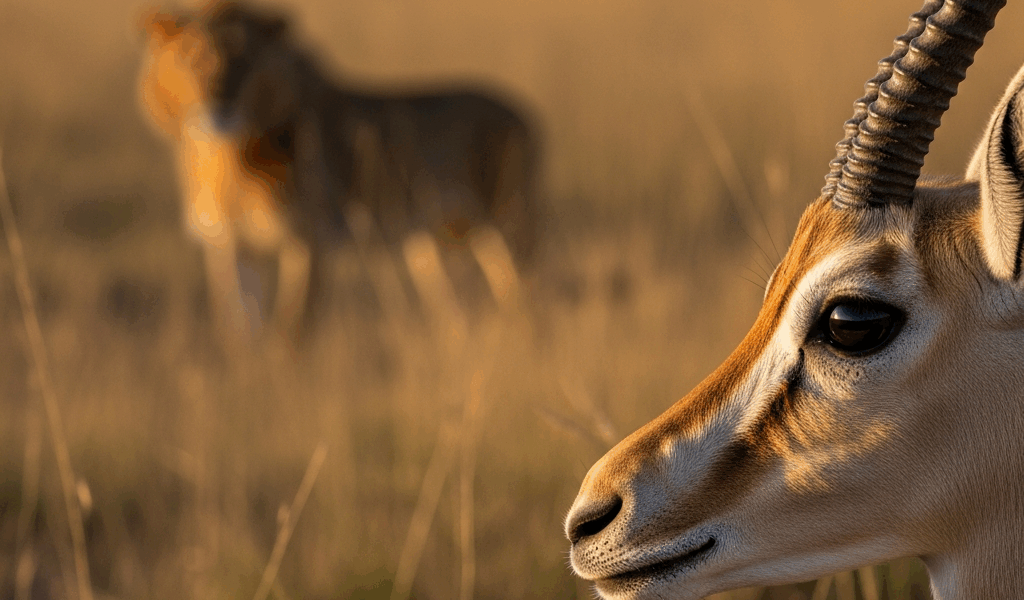
Where an animal’s eyes sit on its skull determines how much of the world it can see at once. That’s the mechanical truth underneath all the biology. Humans, with our forward-facing eyes, get roughly 190 degrees of total visual field. A rabbit clocks in closer to 360 degrees. A horse sits around 340 degrees. A gazelle — one of the most-hunted animals on Earth — sits somewhere in that same band, with a narrow blind spot directly behind the head that’s almost negligible in practice.
This isn’t random placement. Evolution doesn’t do random. Every millimeter those eyes sit further toward the sides of the skull represents a trade that was made under pressure — sometimes fatal pressure. Gazelles, rabbits, and horses all have laterally placed eyes because their ancestors who didn’t died before they passed on the gene. That’s the entire mechanism. Selection pressure is relentless and it doesn’t negotiate.
The cost, though, is real. Prey animals with side-facing eyes sacrifice binocular overlap — the zone where both eyes see the same object simultaneously, which is what creates depth perception. A horse has a binocular field of only about 65 degrees directly in front of it. A rabbit’s binocular zone is even narrower, maybe 30 degrees. Compare that to a human’s 120-degree binocular field, or a hawk’s 50-degree zone that still resolves distance at extraordinary range.
For prey, depth perception is largely expendable. They aren’t judging the distance to something they’re about to grab. They’re running. Running in a straight line away from danger doesn’t require knowing exactly how far the lion is behind you — it requires knowing the lion is there at all.
How Predators Use Forward-Facing Eyes to Compensate
Lions have forward-facing eyes. So do wolves, hawks, and owls. Humans, too — because we evolved as hunters, not prey. That placement isn’t a coincidence. It’s the same evolutionary logic running in reverse.
When a lion stalks a zebra across 80 meters of open grass, it needs to calculate the exact moment to launch. Too early and the zebra escapes into a gallop. Too late and the lion overshoots. That calculation requires precise depth perception — the ability to judge distance to within a few meters at a full sprint. Forward-facing eyes create a wide binocular overlap zone, giving predators the stereoscopic vision that makes this possible.
A red-tailed hawk diving on a rabbit from 30 meters above has to account for wind, the rabbit’s speed and direction, and its own terminal velocity. The margin for error is maybe 10 centimeters. That’s not a task you accomplish with a 340-degree panoramic field and minimal depth resolution. The hawk’s eyes face nearly forward, giving it a binocular field of about 50 degrees with exceptional resolution in the center — exactly what it needs for a precision strike.
What predators sacrifice is peripheral awareness. A lion has a total field of view around 200 degrees — less than a gazelle by about 140 degrees. That blind zone exists because both eyes are pointed the same direction. In practice, this means predators rely on other senses — smell, hearing, movement detection — to compensate for the panoramic vision they gave up. The eye position is a specialization, not a universal improvement. It works because the predator’s survival strategy demands precision over panorama.
Why Prey Animals Can’t Use Depth Perception Like Predators Do
The neurological cost of side-facing eyes runs deeper than just field of view. In essence, depth perception requires the brain to compare two slightly different images of the same object — one from each eye. But it’s much more than that. The wider apart those two images diverge — because your eyes are further from center — the harder that computation becomes at close range, and the less overlap exists between the two visual fields.
A rabbit’s brain receives two almost completely separate images. Left-world and right-world, with a small forward slice where they overlap. The rabbit’s visual cortex processes these as a wide situational panorama, not a depth-resolved scene. It knows something is moving at 11 o’clock. It doesn’t know if that shape is 4 meters away or 14.
For an animal that survives by sprinting and dodging, this is acceptable. The impala doesn’t need to know the cheetah is exactly 47 meters back. It needs to know the cheetah exists and which direction is open. Depth perception becomes critical only when you’re the one closing distance on a target.
Probably should have opened with this section, honestly. Because this is where the trade-off becomes visceral. The animal that sees more of the world pays for that vision with an inability to accurately judge distances within it. The animal that sees less sees what’s there with surgical precision.
Primates make this cost concrete. Many primates — including humans and our closest relatives — are technically prey animals in some contexts, yet have forward-facing eyes. Tree-dwelling primates navigating branches 20 meters above the ground need exact depth perception to avoid a lethal misjudgment of a 30-centimeter gap. They traded panoramic safety for the ability to move accurately through three-dimensional space. The result: they’re far more vulnerable to ambush predators approaching from behind. They compensate with social vigilance — group members watching directions the individual cannot.
The Milliseconds That Matter — When Prey Spot a Predator
Hunted by a savanna full of things that want to kill it, an impala grazing with its head down presents a particular problem: it can’t watch for predators while eating. Or can it?
With eyes positioned on the sides of its skull, an impala grazing in a head-down posture still maintains visual coverage of the horizon in nearly every direction. A lion moving through grass 200 meters away — approaching at roughly 4 meters per second in a controlled stalk — enters the impala’s visual field almost immediately upon movement. The impala’s eye detects peripheral motion with high sensitivity even at low resolution. Threat-assessment response triggers in under a second.
Research on prey-animal escape behavior, including studies on ungulates in African reserves, demonstrates something striking: side-eyed prey animals consistently detect and begin flight responses measurably faster than their visual geometry would predict. Why? Because the panoramic field means threats rarely approach through a blind zone. The detection advantage over a forward-eyed animal in the same scenario is estimated at 0.5 to 1 second.
That number sounds small. It isn’t. A cheetah at full speed covers roughly 30 meters per second. One second of earlier detection translates to 30 meters of head start. At the distances where a cheetah commits to a chase — typically under 100 meters — 30 meters is often the difference between escape and capture. The impala’s eye position isn’t a minor anatomical detail. It is a survival mechanism measured in fractions of a second with lethal stakes.
Which Prey Animals Break the Rule (and Why)
Not every prey animal has side-facing eyes. That’s what makes these exceptions endearing to us evolutionary biologists.
Tree-dwelling primates are the clearest case — squirrel monkeys, capuchins, and most Old World monkeys occupy environments where a misjudged jump means death from falling, not from being eaten. The predator pressure is real but less immediate than the moment-to-moment navigation demand. Forward-facing eyes won out because the habitat required it.
Some ungulates — animals like certain forest-dwelling deer species — have eyes positioned slightly more forward than open-savanna prey. In dense forest, predators can only approach from limited angles dictated by vegetation. That reduces the panoramic advantage significantly. The depth perception gain from a slightly more frontal eye position helps with navigating obstacles at speed.
Mole-rats and some burrowing mammals have eyes so reduced they’re nearly vestigial. Underground, neither panoramic vision nor depth perception matters much. The eyes have been selected for basic light detection rather than spatial awareness.
The rule isn’t universal because evolution responds to local conditions, not universal templates. An animal’s eye position reflects the specific predator pressure, habitat structure, and movement demands of its evolutionary history — not a single blueprint applied across all prey. What holds across nearly every case is the logic: where the threat comes from determines where the eyes point. What you need to do about the threat determines how clearly you need to see it.



Leave a Reply