The Numbers Are Worse Than Most People Realize
Cheetah conservation has gotten complicated with all the misinformation flying around. So let me open with the number that stopped me cold when I first encountered it: roughly 7,000 wild cheetahs left on Earth. One hundred years ago, that figure was closer to 100,000. That’s a 93 percent collapse — not across geological time, not across centuries. Within a single human lifetime.
I stumbled into this during research for a piece on African megafauna. Made the classic mistake immediately — assumed the decline was this slow, steady bleed. It isn’t. The steepest losses have come in the last 30 years, hammering East Africa and the Sahel hardest. That was news to me, and honestly, it should be bigger news to everyone.
The regional breakdown matters more than people give it credit for. Southern Africa holds the largest remaining chunk — around 3,800 animals, mostly spread across Botswana and Namibia. East Africa has maybe 2,000, concentrated near Kenya’s national reserves and the Serengeti. Then there are the Saharan and Iranian populations. Fifty to a hundred animals each. Ranges so fragmented they function as genetic islands. These aren’t separate crises requiring separate solutions. They’re one crisis wearing different regional masks.
Put this in context: the decline outpaces what happened to North American wolves or African elephants during their worst stretches. Wolves bounced back — they breed fast, and humans eventually threw legal protection around them. Cheetahs don’t have that luxury. A female produces maybe three to five cubs every two years. Most don’t reach adulthood. Lose breeding females faster than new ones mature, and the math turns ugly in a way that doesn’t reverse easily.
Habitat Loss Is Cutting Their Territory Into Useless Patches
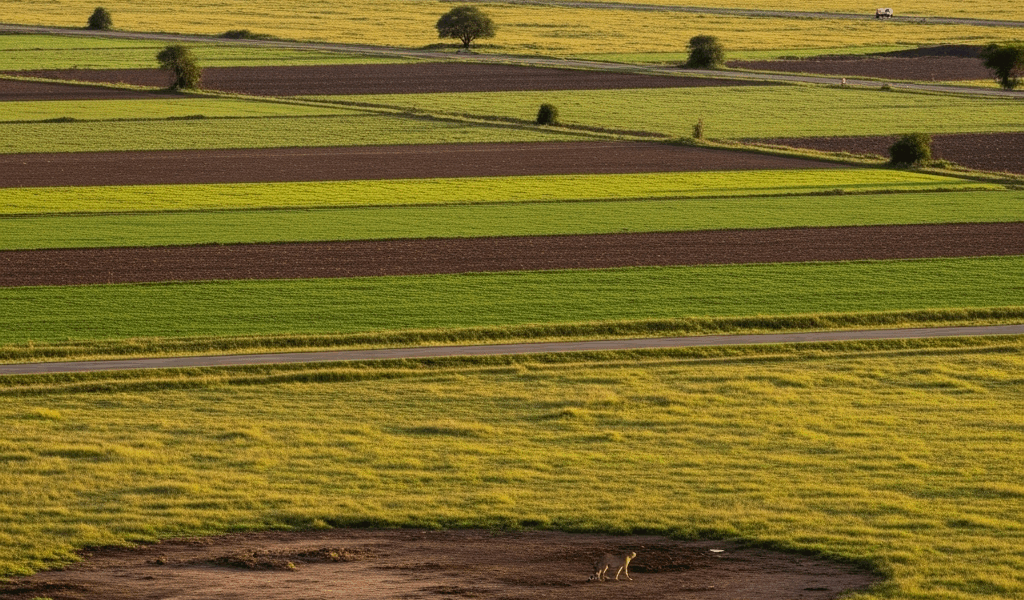
Cheetahs are cursorial hunters. They chase prey at 70 miles per hour — which means they need room. A male’s home range spans somewhere between 800 and 1,500 square miles. Females need roughly 300 to 600. Now picture that range divided up by cattle ranches, crop boundaries, and conservation easements drawn by people who’ve never watched a cheetah hunt.
I learned the mechanics of this problem through conversations with field researchers working in Namibia. Agricultural expansion — cattle farming especially, but game ranching too — fragments the landscape into patches too small to support the prey density cheetahs actually require. A fragmented 200-square-mile territory might carry only half the gazelle and impala population of an intact block the same size. Cheetahs can’t compensate for that by hunting smarter. They need connected ranges where prey stays robust.
Then there’s the fencing. Southern Africa has approximately 90,000 miles of internal fencing across private and commercial land. Ninety thousand miles. These barriers don’t just inconvenience cheetahs — they block movement between habitat patches entirely. A male trying to establish territory can’t reach viable space. A female searching for prey has to cross farmland. Both scenarios end the same way: conflict with humans.
Kenya’s Maasai Mara buffer zones show the identical pattern playing out over two decades. Park boundaries protect the core reserve well enough. But the surrounding pastoral lands have fragmented badly. Cheetahs require movement between the protected area and dispersal corridors — without those corridors, the Mara population becomes a slow extinction event, unfolding quietly across generations while everyone assumes the reserve is doing its job.
Farmers Kill Cheetahs to Protect Livestock — Here Is Why That Keeps Happening
Fragmented habitat doesn’t just isolate cheetah populations. It physically pushes them toward farmland. That’s where retaliatory killing becomes the leading direct cause of cheetah mortality across southern Africa — and it’s worth understanding why this keeps happening before judging anyone for it.
A small-scale farmer in Namibia loses goats worth $30 to $50 each. One cheetah kill can represent one to two weeks of household income. The farmer doesn’t pause to run forensics on which predator made the kill — hyenas, lions, and wild dogs all hunt livestock too — but cheetahs get blamed because they’re visible. Spotted crossing the grazing land in broad daylight. The assumption gets made, and the cheetah dies for it.
Here’s what genuinely surprised me: the Cheetah Conservation Fund documented how often that assumption is simply wrong. In their Namibian study areas, roughly 40 percent of livestock losses attributed to cheetahs were actually caused by other predators. Forty percent. The cheetahs die anyway.
The intervention that actually works is livestock guardian dogs — Anatolian Shepherds and Kangals placed with farming communities. These dogs bond with goat and sheep herds. They defend them actively. The CCF’s program has run since the 1990s, and their data isn’t ambiguous: farms using guardian dogs see 90 percent reductions in predator-caused losses. Retaliatory cheetah killing drops alongside it. A farmer with a working guardian dog has no reason to shoot the cheetah passing through his land at dusk.
The gap isn’t motivation. Most Namibian farmers now have access to the dogs, the training, and the veterinary support. Most Kenyan and Ethiopian farmers don’t. That’s not a moral failure on anyone’s part — it’s a resource allocation problem with a documented solution that hasn’t been scaled to where it’s needed. Probably should have led with that framing, honestly.
The Illegal Pet Trade Is Quietly Emptying Wild Dens
Cubs get taken at three to six weeks old. Trafficked primarily through Somalia and Ethiopia toward Gulf states, where buyers treat them as status symbols — live accessories. An illegal cheetah cub sells for $2,000 to $10,000 depending on lineage and where the transaction happens. Adults don’t fetch that premium. So traffickers target mothers with young litters specifically. That detail matters.
Estimated survival through transport runs under 25 percent. Cubs separated from their mothers lack antibodies, lack proper nutrition, lack the maternal learning that keeps young cheetahs alive. They die from disease, malnutrition, or injury before they reach a buyer. The ones that survive rarely live past five years in captivity.
But what is the real population damage here? In essence, it’s the removal of females before they ever reproduce — but it’s much more than that. When traffickers pull 100 wild cubs and only 20 survive capture, they’ve eliminated animals that would have contributed hundreds of offspring across their reproductive lifespans. It’s a wound to future population growth that’s harder to reverse than ordinary adult mortality. You’re not just losing the animals. You’re losing everything those animals would have produced.
The trafficking route runs through Gulf customs at Doha, Dubai, and Abu Dhabi. These are bottleneck points — exactly the kind of choke in the supply chain where enforcement actually has leverage. A single well-resourced border inspection program could intercept most shipments. Penalties for trafficking remain lower than the profit margin, though, and customs capacity stays inconsistent. Don’t make my mistake of assuming the infrastructure to stop this doesn’t exist. It does. It’s just not prioritized.
What Actually Has to Change for Cheetah Numbers to Recover
I’m apparently someone who fixates on intervention evidence rather than general alarm, and that framing works for me while vague calls to “raise awareness” never really do. So here’s what the evidence actually shows.
Livestock guardian dogs work. The data exists — CCF’s 30-year program in Namibia isn’t a pilot study anymore. Corridor conservation between protected areas works too. When cheetahs can move between viable habitat patches, isolated populations don’t quietly collapse over decades. Anti-trafficking enforcement at Gulf customs would work if it were properly funded and coordinated — the chokepoints are identified, the routes are mapped, the political will is the missing piece.
One honest constraint worth naming: cheetahs carry a genetic bottleneck from the last ice age. Their DNA diversity is unusually low, which makes them vulnerable to disease outbreaks and limits reproductive flexibility. No conservation intervention fixes this. It’s baked in. But it doesn’t justify abandoning recovery efforts — it means protecting existing wild populations from additional pressure becomes even more critical, because there’s less biological buffer when things go wrong.
The numbers are salvageable. Not back to 100,000 — that landscape is gone. But 15,000 to 20,000 stable, connected wild cheetahs across Africa is a plausible target if habitat fragmentation slows, farmer conflict mechanisms get adequately resourced, and trafficking enforcement closes the Gulf customs gaps. That’s what makes cheetah conservation endearing to us as a cause worth fighting for — these aren’t wishes dressed up as strategy. They’re mechanics, with precedents, waiting on execution.



Leave a Reply