Why Do Mountain Gorillas Have Such Small Population Ranges
I’ve spent more time than I probably should reading conservation reports about mountain gorillas, and the question that keeps surfacing isn’t “Are they endangered?” but rather “Why can’t they just move to all that other forest nearby?” The answer isn’t what most people expect — mountain gorillas don’t have small population ranges because humans forced them there recently, or at least that’s only part of the story. Their ranges are constrained by something far more fundamental: their own ecology refuses to cooperate with expansion, even when suitable habitat exists mere kilometers away.
The real puzzle researchers are actually wrestling with? Why roughly 1,000 individuals live in two isolated populations (Virunga Mountains and Bwindi Impenetrable Forest) when a species this successful at surviving seems like it should spread across more territory. The answer involves altitude requirements, food distribution patterns, behavioral territoriality, and historical fragmentation layered together in ways that make expansion genuinely difficult. Not impossible, mind you. Just difficult.
What Actually Limits Mountain Gorilla Movement
Mountain gorillas live at elevations between 2,200 and 4,300 meters. That’s not a casual preference — their entire metabolism, respiratory system, and digestive adaptations evolved for that specific altitude band. Below 2,200 meters, you hit lowland rainforest. Different ecosystem. Different vegetation. Higher parasites. Heat stress that gorillas struggle with.
I learned this distinction while cross-referencing habitat studies from the Dian Fossey Gorilla Fund, and it completely changed how I understood their confinement. A mountain gorilla isn’t choosing altitude like a tourist chooses an Airbnb. Their body chemistry demands it.
The vegetation changes sharply with elevation. At the mountain gorilla’s preferred range, you get montane forest — a specific forest type with dense herbaceous ground cover, wild celery, stinging nettles, and bamboo shoots. These plants are calorie-dense and protein-rich. They’re also geographically specific. Below the mountain zone, the flora shifts entirely. An adult male mountain gorilla (silverback) weighs roughly 180 kilograms and needs to consume about 18 kilograms of vegetation daily. That’s not optional. The lowland forests simply don’t offer those plant species in the abundance required to feed a gorilla group.
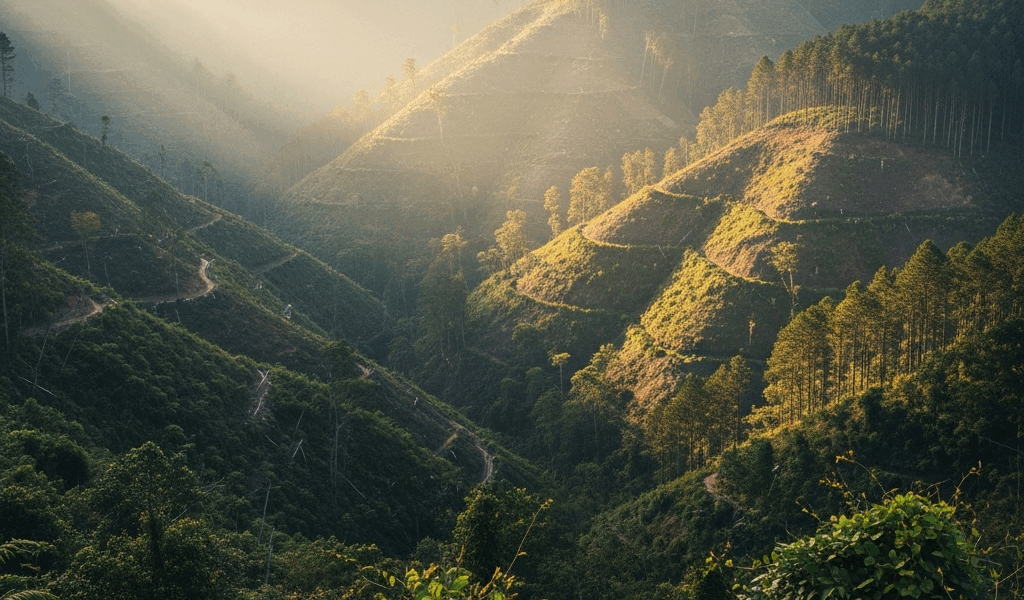
Virunga Mountains — the volcanic range straddling Uganda, Rwanda, and the Democratic Republic of Congo — rises as a series of peaks suitable for gorillas. Mount Karisimbi, the highest, reaches 4,507 meters. But here’s the thing: Virunga doesn’t exist in isolation. Surrounding these mountains are agricultural lands, grasslands, and lowland forests where gorillas cannot metabolically sustain themselves year-round. The mountain itself becomes an island.
Bwindi Impenetrable Forest in southwestern Uganda sits at higher elevations than most tropical forests — ranging from 1,190 to 2,607 meters — which makes it one of the few places where montane conditions extend far enough south to support gorillas. But “impenetrable” isn’t romantic language. It’s accurate. The forest is so dense that even traveling between gorilla groups within Bwindi is an expedition.
The constraints are physical. They’re not political. You cannot legislate around them.
Why Nearby Forests Look Empty to Gorillas
Probably should have opened with this section, honestly. Understanding gorilla territoriality is the key to understanding why habitat expansion fails.
A silverback gorilla doesn’t just occupy a territory. He defines it through constant, deliberate patrolling and chest-beating displays that communicate dominance across kilometers. His presence — and his willingness to fight to maintain it — creates invisible boundaries that other groups recognize and respect. When researchers map gorilla ranges using GPS and behavioral observation, they’re not charting habitat usage. They’re charting the enforced territories of individual silverbacks.
In Virunga, the Karisimbi population is divided among multiple established groups, each claiming specific zones. A new gorilla group cannot simply decide to occupy an adjacent area because that area is already claimed and defended. The defending silverback will fight. These fights are serious — injuries, infanticide, and death occur. Natural selection has programmed gorillas to avoid these confrontations by respecting established territorial boundaries.
Range expansion requires demographic change — a young silverback splitting from his natal group to establish a new territory. But where does he go? He cannot move vertically into higher elevation (already occupied or too cold). He cannot move downslope into lowland forest (metabolically unsuitable). He can only move laterally within the montane zone, and lateral space is fully claimed. There’s no frontier. There are no empty lands waiting for ambitious young males.
This is different from human migration patterns, where economic incentives or political pressure can push populations into new regions. Gorillas move based on internal group dynamics and immediate resource availability. A female seeking a better silverback might transfer between groups, but that’s social flexibility, not range expansion.
Observed by researchers studying Bwindi’s Central and Southwest populations, gorilla groups maintain overlapping but distinct feeding ranges. They don’t share. The silverback’s monopoly on breeding females creates absolute incentive to defend territory. This territoriality isn’t pathological. It’s the organizing principle of their entire social structure. You cannot separate it from the species’ identity.
How Habitat Fragmentation Became a Population Trap
Two hundred years ago, mountain gorillas ranged continuously across a broader montane zone spanning what is now Uganda, Rwanda, Burundi, and the Democratic Republic of Congo. I say “continuously” carefully — there were always population clusters separated by natural features, but genetic exchange and range shifts were possible. That was the baseline.
Then deforestation began in earnest. By the 1950s, surrounding lowland forests were cleared for agriculture, grazing, and timber. Montane forests were targeted next. Colonial administrators, early national governments, and subsistence farmers pushed the forest line upward. The continuous montane habitat fragmented into disconnected blocks.
By the 1970s, when Dian Fossey was conducting her landmark research in Virunga, the fragmentation was irreversible. The Virunga population became genetically isolated from populations in what is now Bwindi — roughly 1,200 kilometers away. Between them stretched agricultural land, human settlements, and lowland forest. A barrier as absolute as a mountain range.
The Bwindi population itself fractured into distinct groups. Researchers identify at least 36 groups currently living in Bwindi, ranging from small family units to larger congregations. These groups don’t interbreed across certain geographic boundaries because the territory-holding silverbacks prevent movement through the forest.
What’s crucial is that the fragmentation didn’t just reduce gorilla numbers. It created a trap. Once populations are isolated, they cannot recolonize adjacent habitat even if restoration efforts make that habitat available. A young silverback born in the Rushegura group within Bwindi cannot establish a new territory in the next valley because that valley is already claimed. He cannot move between Bwindi and Virunga because the corridor doesn’t exist and would require crossing hostile human-dominated landscape.
The fragmentation created islands. Islands don’t produce males looking for new territory.
Can Mountain Gorillas Ever Expand Their Range Again
Reintroduction and corridor creation sound elegant in theory. In practice, they’re attempting to solve a behavioral problem using habitat management — which is why results have been mixed.
Rwanda has created limited forest corridors connecting Virunga to nearby protected areas, specifically to allow genetic exchange between silverback groups. The results have been modest. A few individuals have moved through the corridors. Most established groups remain territorially fixed. The corridors need to be wide enough that young males feel safe dispersing, and they need to connect to habitat with resources and acceptable population density. Creating that on land where humans depend on agriculture is politically and practically difficult.
Reintroduction — taking captive-born or relocated gorillas and establishing them in new territories — has been attempted elsewhere in Africa (particularly with lowland gorillas), but mountain gorilla reintroduction has never been seriously attempted at scale. The behavioral challenges are immense. A reintroduced silverback must establish dominance in a new territory against existing groups. A reintroduced female must integrate into a social hierarchy managed by an established silverback. These aren’t abstract concerns. They involve violence, infanticide risk, and death.
What researchers are genuinely uncertain about is whether genetic rescue is possible through managed breeding programs. If Bwindi and Virunga populations are genetically diverging too rapidly — accumulating mutations at different rates — they might eventually become reproductively incompatible. We don’t know if that’s happening yet. The populations are still genetically viable as separate units. Whether they can remain viable long-term in isolation is an open question.
Some conservation groups are exploring micro-translocation — moving individual gorillas between protected areas within the same region to increase genetic mixing. It’s working slowly. It’s also expensive and dangerous for the animals involved.
What This Means for Their Long-Term Survival
A stable population of 1,000 individuals sounds precarious when you know that genetic bottlenecks can reduce viability. Mountain gorillas aren’t declining rapidly anymore — the Virunga population has actually grown modestly — but stability isn’t the same as security.
Confined populations accumulate genetic drift faster than connected ones. Recessive mutations that would be diluted in a large, diverse population become more frequent in a small, isolated group. This hasn’t yet manifested as obvious genetic problems in mountain gorillas, but the risk increases with time.
The real vulnerability isn’t poaching or habitat loss in the near term — anti-poaching efforts have been effective. The vulnerability is ecological stagnation. Mountain gorillas cannot adapt range-wise to climate change. They cannot shift elevation if their current altitude becomes unsuitable. They cannot escape disease outbreaks by dispersing into new populations. They’re trapped in a small geographic area with limited capacity to respond to future pressures.
What researchers are asking now is whether the constraint is permanent or whether restoration work could eventually expand the viable range. Creating continuous montane forest across hundreds of kilometers would require reversing centuries of agricultural use. Theoretically possible. Politically unlikely.
The honest answer is that mountain gorillas have small population ranges because their ecology is inflexible, their behavior is territorially rigid, and their habitat was fragmented by humans in ways that are extraordinarily difficult to reverse. They’re not choosing confinement. They’re unable to escape it.



Leave a Reply