How Much Bigger Are a Nocturnal Animal’s Eyes Really
Nocturnal animals and their eye proportions—I’ve spent enough time staring at the numbers to know that a tarsier’s eyeballs are genuinely unsettling. Those enormous orbs take up most of its skull. Each eye weighs roughly 0.8 grams on a 150-gram body. Scale that to a human? My eyes would be the size of grapefruits. A nocturnal leopard has eyes about 40% larger than a diurnal lion of similar body weight, and honestly, that difference isn’t accidental design. It’s survival hardwired into their biology.
The gap matters because it’s not cosmetic.
When I first encountered these eye-size ratios, I expected a modest difference — maybe 20% bigger at most. Instead, nocturnal species routinely have eyes twice the diameter of their diurnal cousins. A bush baby’s eyes measure roughly 16mm in diameter despite the animal weighing only 200 grams. Compare that to a squirrel of identical size, and you’re looking at maybe 8mm. The nocturnal animal has invested metabolic energy into eyes that dominate its face, while the diurnal animal got away with smaller optical hardware. This isn’t about aesthetics. It’s about photons.
The Physics of Seeing in Low Light
Here’s where it gets interesting: understanding why nocturnal animals evolved larger eyes requires knowing how light actually enters the eye. The pupil — that opening that controls how many photons reach the retina. A larger pupil means more light gets through.
Think of it like a camera aperture. Wide aperture setting (low f-number) pulls in more light than a narrow one does. A nocturnal animal’s pupil can dilate much wider than a human’s. Mine dilate fully to about 8mm. A cat’s pupils hit 16mm. That 8mm difference doubles the light-gathering area — because area scales with the square of diameter. A tarsier’s pupils can expand to nearly its entire eye surface. Barely a ring of iris visible.
But pupil size alone doesn’t explain the eye size difference.
The real magic happens in the retina, specifically in how photoreceptor cells get distributed. Nocturnal animals pack disproportionate numbers of rod cells — the photoreceptors sensitive to low light. A human retina contains roughly 120 million rods and 6 million cones. An owl’s retina flips that ratio dramatically toward rods. More rods means more light sensors distributed across the back of the eye, so even dim photons have a better chance of hitting a cell that can respond.
Larger eyes also mean a longer focal length, which improves light sensitivity through another optical principle. The back of the eye sits farther from the lens, allowing light to spread across more photoreceptor cells before being “read” by the brain. Probably should have opened with this section, honestly — it’s the mechanical foundation for everything else.
Many nocturnal species possess a reflective layer behind the retina called the tapetum lucidum. It bounces light back through the photoreceptor layer a second time, essentially giving dim light a second chance to register. That’s why nocturnal animal eyes glow in flashlight beams — the light reflects off this mirror layer and exits back through the pupil. Humans lack this layer entirely, which is why we’re terrible night hunters compared to our mammalian competitors.
Real Examples — Nocturnal vs. Diurnal Hunters
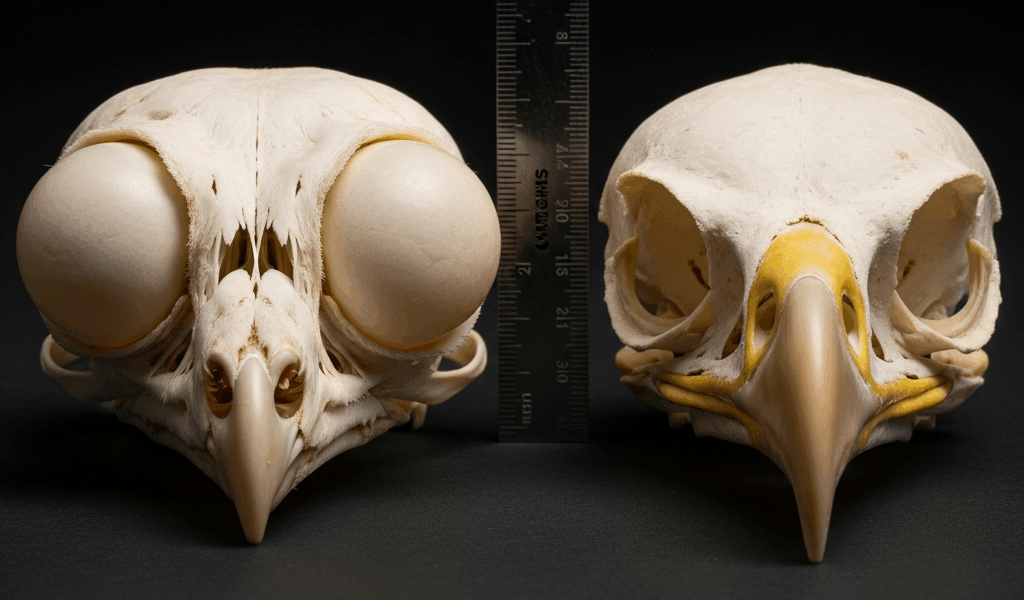
Owl eyes sit in sockets so large they can barely move. An eagle owl’s eyes measure roughly 50mm in diameter — larger than a human’s in absolute terms, despite the bird weighing less than 5kg. A red-tailed hawk, which hunts during daylight, has eyes around 18mm in diameter. Both birds hunt similar prey. One relies on size and light sensitivity. The other compensates with exceptional color vision and motion detection in bright conditions.
The nocturnal advantage comes with trade-offs. An owl’s massive eyes don’t rotate in their sockets like a human’s. Instead, the entire head rotates — 270 degrees in some species — to direct those fixed, forward-facing optics. A hawk’s smaller eyes provide broader peripheral vision without moving its head, an asset when scanning daylit territories from above.
Lemurs offer a primate comparison. Ring-tailed lemurs (diurnal) have eye diameters around 9-10mm. Aye-ayes (nocturnal) hit 16-18mm on smaller bodies. That’s nearly double the light-gathering capacity. But the aye-aye sacrificed color vision — nocturnal species monotonously lack the ability to distinguish red and green wavelengths that diurnal animals rely on. When you hunt at night, wavelength discrimination becomes noise. Sensitivity to any available light becomes everything.
Bush babies and tree shrews show the same pattern. The nocturnal bushbaby has enormous forward-facing eyes optimized for detecting movement in near-darkness. The diurnal tree shrew has smaller, more laterally positioned eyes suited for scanning a bright canopy. Same ecological niche (small arboreal insectivores), wildly different optical strategies.
The Cost of Big Eyes for Nocturnal Animals
Larger eyes aren’t free.
First, there’s the skull constraint. Massive eye sockets require bigger eye muscles, stronger bone around them, and a heavier head overall. A tarsier’s skull is disproportionately massive relative to body size because the eyes demand it. That weight creates biomechanical stress on the neck and consumes energy during locomotion. The animal must burn calories just moving its oversized head.
Second, there’s the metabolic cost of maintaining photoreceptor cells. Rod cells consume oxygen and glucose continuously, even in darkness. A nocturnal eye packed with rods requires constant metabolic fueling. Nocturnal animals must eat more frequently or store more fat reserves than diurnal counterparts of the same size — a real constraint in environments where food is unpredictable.
Third, large eyes filled with fluid and tissue are fragile. A nocturnal animal’s enormous eyes sit exposed in its skull, making it vulnerable to injury during movement through dense vegetation at night. I’ve observed nocturnal primates with scarred faces, often around the eyes, from collision injuries that would be unlikely in a diurnal species moving through the same terrain in daylight.
Color vision disappears almost entirely. Nocturnal species retain few cone cells, so they see the world in shades of gray and blue. A diurnal animal perceives a full rainbow. That’s a genuine loss, though it seems trivial when you’re hunting in near-total darkness.
There’s also a learning cost. Nocturnal animals develop the ability to interpret dim, low-contrast images into meaningful spatial data. That requires neural processing power and developmental time. Young nocturnal animals must spend extended periods learning to navigate and hunt in darkness — they can’t rely on the same visual shortcuts as diurnal young.
How This Shapes Behavior and Habitat
Eye size determines where an animal can hunt and when.
A nocturnal animal with maxed-out eye capacity can hunt in moonlight or starlight alone. It doesn’t need the full luminosity a diurnal predator demands. This opens up entire ecological niches — predating on insects under tree canopy, hunting small mammals in open grassland after sunset, fishing in rivers where surface light barely penetrates. A diurnal species is locked out of these opportunities.
Conversely, nocturnal animals are helpless in daylight. They physically cannot gather enough light information for clear vision in bright sun. Many nocturnal species are actually photophobic — light sensitivity in their eyes makes daylight painful. They’re not just poor at day hunting; they’re neurologically adverse to it. Evolution locked them into their niche.
This shapes social behavior too. Many nocturnal species evolved solitary lifestyles because social cohesion in darkness requires different strategies than in daylight. Diurnal animals coordinate visually across distances. Nocturnal species rely more on chemical signals, vocalizations, and tactile contact. Lemurs, which are unusual among primates for being nocturnal in some species and diurnal in others, show measurable social complexity differences tied directly to their activity pattern and associated eye size.
Understanding these adaptations matters for conservation. When habitat loss fragments nocturnal animal populations, the specialized eye structure that evolved over millions of years becomes a liability in fragmented landscapes. A nocturnal species cannot simply shift to daytime activity if its habitat shrinks — its eyes are locked into low-light operation. That physiological constraint becomes an extinction risk in the modern world. Protecting nocturnal species means protecting intact nighttime habitats, not just preserving land area.




Leave a Reply