“`html
Why Identifying Individual Primates Matters More Than You’d Think
How do scientists identify individual primates in dense forests? Honestly, this is the question that separates real primate research from the nature documentary version most people see. I spent three weeks in equatorial Congo watching researchers work, and I quickly realized that tracking behavior patterns, health status, or population dynamics requires knowing exactly which individual is which—not just “a macaque” but “that macaque, the one with the healed canine bite.”
Visual identification alone fails spectacularly in dense forest. Canopy cover blocks direct sight lines. Animals move rapidly between trees. Many species look nearly identical to untrained eyes — a troop of 40 howler monkeys might contain 15 individuals that appear to observers as one dark blur. Without reliable identification methods, researchers can’t answer basic conservation questions: Is the population growing or shrinking? Are specific individuals sick? Which animals are related, and how does kinship structure social dynamics? The stakes matter. If you can’t count individuals reliably, you can’t manage endangered populations effectively.
Vocal Signature Recognition in Primate Populations
Individual primates have distinct voices. Not metaphorically—acoustically distinct, measurable, repeatable. Gibbons perform elaborate duets in pairs, and each individual’s song contains frequency patterns, phrase lengths, and tonal qualities unique enough that researchers can identify them from hundreds of meters away, even through dense vegetation.
Here’s what the method actually looks like: researchers deploy digital recorders throughout a study site. A Zoom H5 runs about $300, standard equipment. They capture vocalizations at 44.1 kHz or higher. Software like RAVEN — developed at Cornell’s Lab of Ornithology, available free for non-commercial use — allows spectral analysis. Researchers create a visual fingerprint of each individual’s call: the exact frequencies, the pattern of harmonics, the duration of specific elements. A chimpanzee’s pant-hoot, which travels through forest and carries complex individual information, gets broken down into measurable acoustic parameters.
Background noise kills this approach. Rain on leaves, wind, competing animal calls, insect choruses — all of it masks the target vocalizations. I watched a researcher in Tanzania spend four hours reviewing recordings, discarding 90% because the gibbon calls overlapped with cicada noise. The software couldn’t distinguish them reliably. New individuals arriving in a study area require multiple recordings across different seasons and contexts to confirm their acoustic signature doesn’t shift with stress, age, or seasonal conditions. Vocal identification works best for loud, distinctive species. For quiet primates or those that vocalize infrequently? It’s insufficient alone.
Physical Scars, Markings, and Distinctive Features
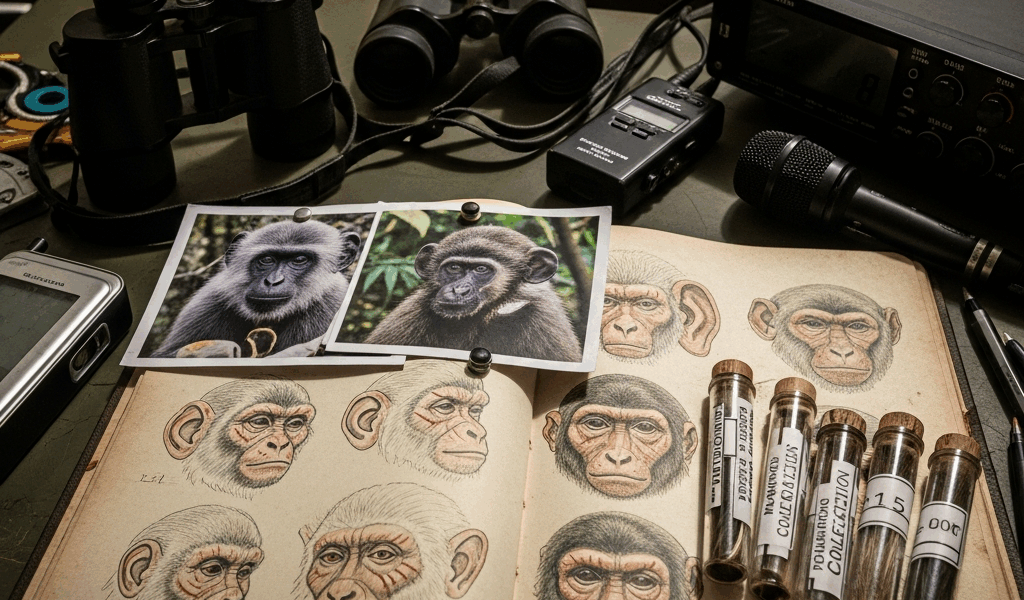
This is where field notebooks become detective work. Individual primates accumulate identifying marks: facial scars from fights, missing or broken digits, distinctive fur patterns, asymmetrical ears, healed injuries that create permanent landmarks on the face or body.
Researchers photograph subjects extensively. Modern field kits include mirrorless cameras — Canon R50 or Nikon Z9 with telephoto lenses (400–600mm) that run $1,500 to $4,000. They take hundreds of reference photos per individual, always from standardized angles (frontal face, profile, three-quarter view). These images enter comparison databases. Some research stations now use photogrammetry, creating 3D models from multiple 2D photos. Software can automatically flag facial matches, reducing manual comparison work.
Facial recognition works phenomenally well for species with expressive faces and visible variation — orangutans, gorillas, some macaque populations. For highly uniform species, like certain lemur groups, it’s nearly useless. Scars fade over time or become obscured by new fur growth. A young individual without any notable marks presents a genuine identification problem. And this only works if researchers can get clear photographs. In thick canopy, with animals constantly moving and positioning themselves to avoid observation, getting a usable facial photo might require hours of patient tracking.
DNA and Hair Sample Collection Without Disruption
Genetic analysis creates an unambiguous fingerprint. Every individual has unique DNA — excepting identical twins, rare in wild primates. Non-invasive sampling lets researchers collect shed hair, fecal samples, or saliva from vegetation and build a genetic database without capturing or stressing the animals.
The practical process works like this: researchers move slowly through habitat, scanning for fecal deposits or hair caught on branches. They collect samples in sterile tubes, using gloves and flame-sterilized forceps to prevent contamination. Back at a field lab, or shipped to a university facility, technicians extract DNA and analyze microsatellite markers — specific regions where DNA sequences vary between individuals. The result is a genetic ID unique to that individual, valid for life.
Why prefer this over capture-based methods? Non-invasive sampling avoids the stress and injury risk of live capture. No sedation, no handling, no risk of the animal injuring itself or handlers. It’s ethically superior and practically easier on researchers’ shoulders — honestly, fewer injuries that way. The trade-off: genetic analysis takes weeks or months. You can’t make real-time identifications in the field. You’re analyzing the animal after the fact, integrating genetic data with behavioral observations made across multiple encounters.
The cost runs roughly $15–$50 per sample for microsatellite analysis depending on the lab and funding source. For a long-term study tracking 50 individuals over 10 years, genetic confirmation becomes expensive but invaluable for resolving ambiguous cases.
Radio Collars and Tracking Technology for Long-Term Monitoring
GPS and radio collars enable continuous tracking, giving researchers precise location data without direct observation. An animal fitted with a collar becomes a moving data point, broadcasting its position and activity patterns automatically.
This sounds revolutionary. In practice, it’s genuinely complicated. Radio collars work best on larger primates — chimpanzees, gorillas, baboons — where the collar doesn’t represent a significant weight burden. Smaller primates would be stressed or burdened by the hardware. Battery life is another constraint: collars last 12–36 months depending on GPS frequency and model. After that, researchers face the choice of recapturing the animal (stressful, risky) or losing tracking data.
Forest canopy degrades GPS signals severely. In dense rainforest, a collar’s location estimate might be accurate only to 50 meters or more — useless for fine-grained behavioral work. Radio collars using VHF technology (older but proven) work better under canopy but require researchers to actively track the signal with handheld receivers, a labor-intensive method that demands constant presence.
Ethical constraints limit collar use. Most research ethics boards require strong justification. Is the information gained worth the potential welfare impact? For endangered species where every individual matters — mountain gorillas, Javan slow lorises — the calculus shifts. For common species in stable populations, collars are harder to justify.
The Real-World Limits of Primate Identification
Probably should have opened with this section, honestly. Some species are genuinely hard to distinguish individually. Certain nocturnal lemurs, uniformly colored and solitary, present nearly impossible identification challenges. Researchers studying them often resort to temporary capture-based marking — paint marks or ear tags — or accept that population-level data is the best they can manage.
When researchers can’t tell individuals apart, conservation management suffers. Population counts become estimates with large error margins. You can’t track which animals breed successfully or fail. You can’t detect if a seemingly stable population is actually suffering from low juvenile survival masked by immigration from elsewhere. For critically endangered species, this uncertainty can lead to failed conservation strategies based on incomplete information.
The honest answer: primate identification in dense forests remains a blend of technology, patience, and accepting limitations. No single method works universally. The best research combines multiple approaches — vocal recording, photographic documentation, genetic sampling — to build redundant confirmation of individual identity. This takes years, hundreds of hours in the field, and willingness to say “I’m not certain” about ambiguous cases.
“`




Leave a Reply