Why Individual Identification Matters in Dolphin Research
Tracking individual dolphins in the wild isn’t just academic curiosity — it’s the foundation of everything we know about dolphin behavior, survival, and population health. Without knowing which dolphin is which, researchers can’t measure breeding success, monitor migration patterns, or understand how individuals respond to environmental changes.
I started learning about this through a marine biology elective in college, and what struck me immediately was how different this challenge is from tracking, say, whales or seals. Most large marine mammals have relatively stable identifying features. A humpback whale’s tail flukes are like fingerprints, consistent throughout life. Dolphins? They’re trickier. They move in groups, surface unpredictably, and their key identifying marks—dorsal fins, scars, pigmentation patterns—can change over years or become obscured by water conditions.
The payoff is substantial though. By following individual dolphins across years or decades, researchers track reproductive rates, measure how long individuals live, document social bonds, and even assess responses to noise pollution or food availability. In the Moray Firth population off Scotland, individual identification revealed that female dolphins with stable social partnerships had higher reproductive success — a finding that would’ve been impossible without knowing exactly who was who.
Photo-ID: Reading the Dolphin’s Natural Fingerprint
Photo-identification is the workhorse method. Researchers photograph wild dolphins and build catalogs based on permanent or semi-permanent marks. Each dolphin accumulates a unique constellation of identifying features over its lifetime.
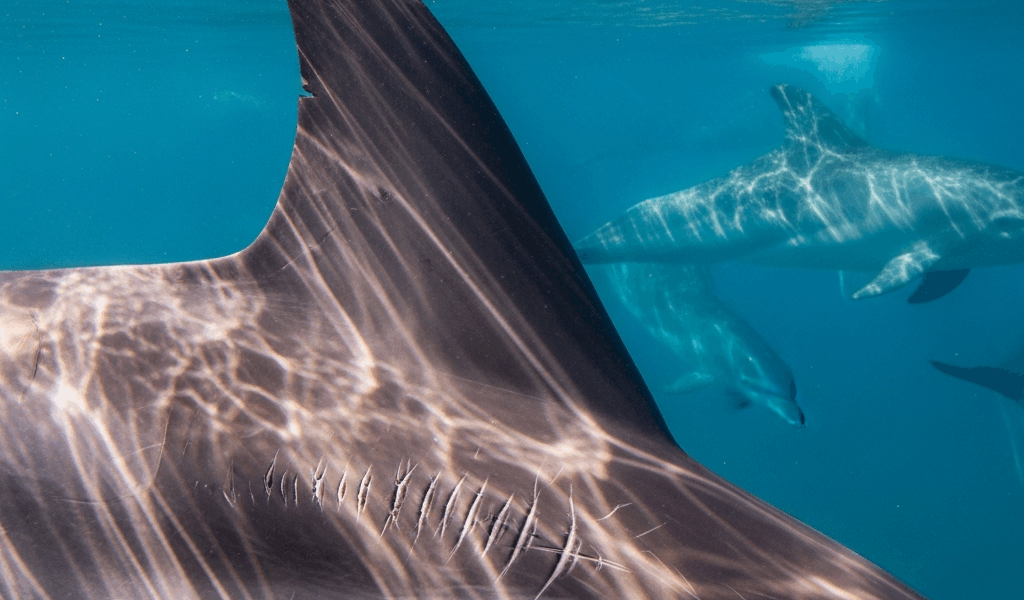
The primary signature is the dorsal fin. Most dolphins develop notches, nicks, and irregular edges as they age. These aren’t random — a dolphin with a distinctive three-pronged notch on the left side of its fin coupled with two deep scars will have that exact pattern every time it surfaces. Pigmentation patterns matter too. Bottlenose dolphins, particularly in coastal populations, develop blotchy gray-and-white patterns that intensify with age. Spotted dolphins (Atlantic spotted dolphins, *Stenella frontalis*) literally get more spotted as they mature. A juvenile might have just a few marks, while a 20-year-old looks nearly speckled.
Scarring provides another layer of detail. Rake marks from teeth — left by aggressive encounters with other dolphins — create thin parallel lines across the body. Net scars from fishing gear entanglement create distinctive puckered patterns. A dolphin named BB-43 in a Florida study became identifiable specifically because of a prominent net scar running across its back, acquired years before the research began.
The operational process sounds simpler than it is. Researchers photograph dolphins from boats or drones, capturing the dorsal fin profile in clear, perpendicular angles. They catalog thousands of these images, organizing by fin characteristics, location, and date. When a dolphin resurfaces, researchers compare the new image against existing catalogs. Modern systems use specialized software that highlights key features — the fin’s leading and trailing edges, notch patterns, scars — making pattern-matching faster and more reliable than eyeballing alone.
Probably should have opened with this section, honestly. The practical challenges are what make photo-ID both powerful and frustrating. Water clarity matters enormously. Tropical or subtropical waters offer 30–50 feet of visibility; murky estuary water might offer three feet. Angle matters — a dorsal fin photographed at a shallow angle looks completely different than one captured perpendicular to the boat. Sunlight, glare, and wave action can obscure critical details. A dolphin scarred by fishing line might heal and regenerate skin, altering the exact appearance of old markings. Researchers account for this through redundancy. They track multiple marks simultaneously, not just a single fin feature.
The Moray Firth bottlenose dolphin population demonstrates the method’s power. Studied continuously since the mid-1980s by the Moray Firth Dolphin Project, researchers photographed 130+ individuals across 35+ years using consistent methodology. That continuity revealed that certain females lived into their 40s, produced 8–10 calves, and maintained social bonds with specific pod members across decades. None of that would’ve been knowable without individual identification.
Acoustic Identification: Using Whistles and Clicks
Dolphins vocalize constantly. They echolocate with rapid clicks. They communicate with whistles that vary in frequency, duration, and shape. And here’s the remarkable part — many dolphins have individually distinctive signature whistles. Essentially their names.
This discovery came in the 1960s when researchers noticed that individual bottlenose dolphins produced consistent, recognizable whistle patterns even when isolated. A dolphin might produce a downward-sloping whistle at 8–12 kHz that lasts 0.8 seconds. Another produces a double-looped pattern. These aren’t learned from the environment. They’re stable acoustic signatures that persist across the dolphin’s life.
Recording these requires hydrophones — underwater microphones deployed from boats or stationary moorings. A typical hydrophone costs $3,000–$15,000 depending on sensitivity and frequency range. Researchers record for hours or days, capturing all vocalizations in an area. Audio files then get analyzed using spectrogram software — tools like RAVEN or PAMGUARD that visualize sound as frequency over time, transforming audio into visible patterns.
The spectrogram shows whistles as distinct traces. A researcher compares the shape, frequency sweep, and duration of a recorded whistle against a catalog of known individuals. “This is Speaker-15, producing her characteristic ascending whistle,” a researcher might note. Clicks, which occur at faster rates (50–1,200 per second), can also identify individuals through click rate and frequency content, though this is less developed than whistle identification.
Acoustic methods excel where photo-ID fails. In river systems with poor visibility — the Amazon, the Ganges, the Yangtze — researchers can’t photograph dolphins reliably. But they can record. Vaquita, the critically endangered porpoise (a cetacean relative), and river dolphins like the pink river dolphin are studied primarily through acoustic monitoring. In the Ganges, researchers used hydrophone arrays to track individual Ganges river dolphins (*Platanista gangetica*) across a 50-kilometer stretch of river where visual observation was nearly impossible.
The limitation? Acoustic identification requires calm conditions and good recording equipment. Storms, ship noise, and coastal industrial activity create acoustic clutter. A recording might capture five overlapping dolphins vocalizing simultaneously, making individual attribution ambiguous. Deep-ocean dolphins that live in low-light environments and vocalize less frequently are harder to catalog acoustively. That’s where the two methods complement each other. Photo-ID for coastal populations in clear water, acoustic methods for murky rivers and deep-ocean regions.
Building and Maintaining Identification Databases
A single researcher photographing dolphins produces hundreds of images per field day. Over decades, catalogs grow into massive databases. The Moray Firth project holds over 100,000 dorsal fin photographs. The Sarasota Dolphin Research Program in Florida maintains records on 1,600+ individually identified bottlenose dolphins spanning 50+ years.
Managing this requires standardized protocols and collaborative infrastructure. Researchers use custom databases that include image metadata (date, location, photographer, water conditions), individual identifiers, and taxonomic information. Software like the Wildbook platform — open-source and used globally — allows researchers to upload images, flag distinctive features, and cross-reference matches across institutions and regions.
Collaborative international efforts amplify the value. The Aegean Sea dolphin populations studied by researchers in Greece share stock with populations studied in Turkey and other eastern Mediterranean regions. When catalogs are shared, a dolphin photographed in Greek waters in 2015 can be re-identified in Turkish waters in 2020, revealing migration and range dynamics that no single researcher or country could uncover alone.
Real operational challenges emerge constantly. New calves born each year require catalog entries. Dolphins that don’t resurface for years might reappear, requiring confirmation that the identified individual is indeed the same one from 2010 or 2015. Injury-caused changes to dorsal fins — a bite mark, a healing wound — can temporarily alter a fin’s appearance. Seasonal variations in scarring visibility due to wound healing or algae growth create false matches if researchers aren’t careful. Software helps, but expert human judgment remains essential.
Limitations and Emerging Technologies
Photo-ID and acoustic methods aren’t perfect. They struggle with juveniles, whose identifying marks are subtle and still developing. A calf born last year might have barely visible dorsal fin notches, making individual matching unreliable. Rapid population turnover — high birth and death rates — means catalogs become outdated faster than in stable populations.
In regions with high dolphin mortality from fishing nets, disease, or predation, tracking individuals becomes logistically harder. If 20 percent of a population turns over annually, maintaining a current, accurate catalog requires constant field effort. The incentive and funding often don’t match the challenge.
Emerging technologies are beginning to fill some gaps. Drone photography, captured from 50–100 meters up, provides unprecedented image clarity without the boat-disturbance effects that sometimes cause dolphins to dive or flee. Environmental DNA sampling — collecting DNA from water where dolphins have recently been present — can identify species and potentially individuals, though the technology is still early. Satellite tags attached to dorsal fins track movement and diving behavior in ways stationary photo-ID can’t, though tagging itself is invasive and raises ethical questions.
What’s proven and operational? Photo-ID and acoustic identification. What’s emerging but not yet standard? Drone imaging is increasingly common, particularly for larger populations. Environmental DNA for dolphin identification remains experimental. Cost and technical difficulty limit current applications. Genetic biopsy samples, collected via remotely deployed darts, do exist and provide individual identification through DNA fingerprinting, but logistically it’s more complex than photography or acoustic recording.
The future probably involves integration — combining photo-ID accuracy, acoustic signatures, and drone imagery to build redundant, multi-method catalogs that are more robust than any single approach. But for now, if you want to identify individual dolphins in the wild reliably, you photograph their fins or listen to their whistles. Low-tech but proven.



Leave a Reply