“`html
How Do Scientists Identify Individual Animals by Their Scars
I first learned about scar-based animal identification while reading a research paper on African leopard populations, and honestly, I was shocked at how effective the method actually is. Wildlife researchers have been quietly using scars, scratches, and distinctive markings to track individual animals for decades—no fancy equipment required. It’s one of the most elegant non-invasive techniques in field biology, and once you understand how it works, you start seeing it everywhere in conservation literature.
The primary appeal is straightforward: scars are permanent, visible, and unique to each animal. A researcher spots a leopard with a torn ear and a distinctive gash across its shoulder, snaps a photograph, and that individual is instantly cataloged. Years later, when the same leopard appears in a camera trap photo 50 kilometers away, the scar pattern confirms it’s the same individual—no blood samples, no radio collars, no stress to the animal.
Why Scientists Use Scars Instead of Tags or DNA
Radio collars and GPS trackers dominate wildlife research headlines. But they come with serious baggage. A standard satellite collar costs $3,000 to $8,000 per unit—that’s before you factor in the capture team, veterinary staff, and risk assessment. You need to corner the animal, which risks injury and behavioral disruption. The collar eventually dies, falls off, or requires retrieval. For endangered species, the capture itself can trigger mortality.
Then there’s genetic sampling—blood draws, hair samples. You get incredible data about kinship and population structure. But it requires handling. You’re limited by how many animals you can safely immobilize in a season. DNA analysis takes weeks in the lab and costs $50 to $200 per sample depending on the markers you’re analyzing.
Scar identification sidesteps all of this. A researcher observing from a distance—or reviewing camera trap footage shot automatically—can catalog individuals with zero capture, zero stress, and minimal equipment. You need a decent camera, good field notes, and patience. That’s genuinely it.
The method works across forests, savannas, oceans, and mountains. It works for apex predators that are dangerous to approach. It works for migratory species where tracking technology becomes impractical because, well, you can’t exactly collar a whale that migrates between hemispheres.
Economically, this matters. Conservation budgets are perpetually thin. A long-term study using scar identification can be conducted for a fraction of the cost of a collaring program. One research team I read about tracked 40 individual jaguars across a reserve in Brazil using exclusively photographic documentation and scar cataloging. The annual budget was roughly $18,000. A comparable GPS collaring study would’ve run closer to $250,000.
Ethically, there’s a clear advantage too. If your research method is non-invasive, you’re gathering knowledge without imposing measurable harm. The animal’s behavior remains natural. Its social hierarchy isn’t disrupted by the stress of capture.
How Researchers Document and Match Scar Patterns
The actual fieldwork is methodical and slightly obsessive.
When a researcher encounters an animal, they photograph it from multiple angles—usually the left side, right side, and head-on views. Lighting matters enormously. Backlighting reveals scars that frontal illumination would miss. An experienced field biologist will photograph the same individual from 8 to 12 different angles if circumstances allow. The goal is exhaustive documentation of every visible mark. I’m apparently that type of researcher, and yes, I’ve been known to spend 45 minutes circling a leopard just to capture every scar from optimal lighting angles.
Photography standards are strict. Researchers use consistent focal lengths—often 200mm telephoto lenses to maintain distance. They note the date, time, location, and exact weather conditions. The image metadata gets embedded with GPS coordinates. A single leopard encounter might generate 40 to 60 photographs.
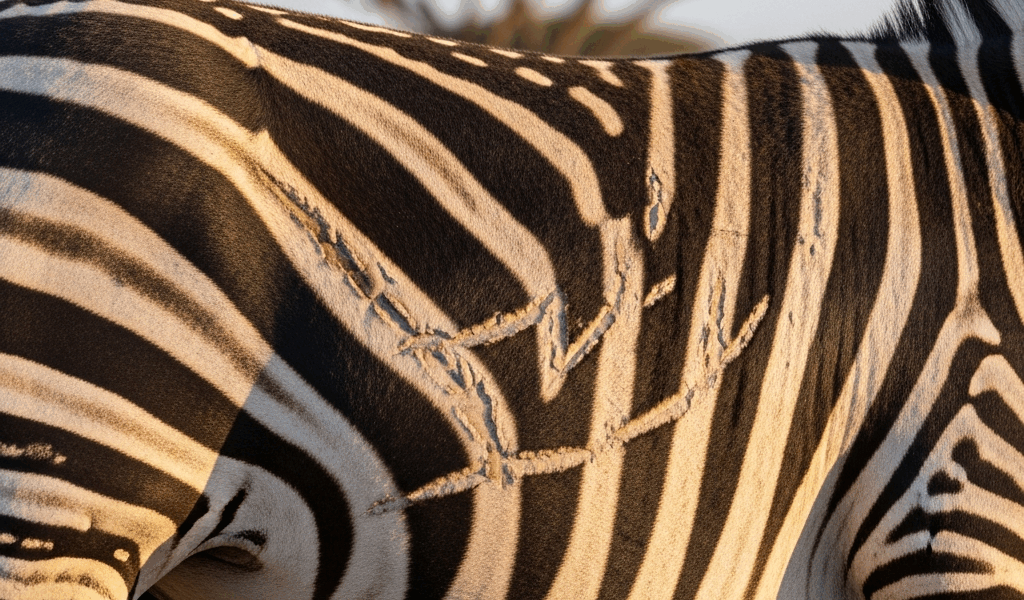
In the field notebook, researchers sketch a simple body diagram. Think of it like a damage report for a car. They mark scar locations with pen: “Right ear, posterior notch. Left shoulder, three parallel scratches running dorsoventrally. Tail base, white scar tissue approximately 3cm long.” They estimate scar age when possible—fresh wounds are reddish or pink, older scars turn white and may develop hair over them.
Back at the field station or office, cataloging begins. Each individual receives a code—maybe “Leopard-47” or “Jaguar-F-12.” All photographs for that individual are digitally filed together. Researchers create detailed profiles with sketches, measurements, and scar locations noted in text. A comprehensive individual record might include 50+ field photos spanning multiple sightings across several years.
When a new animal is encountered, the researcher systematically compares its scar pattern to existing records. Modern field teams often use spreadsheets or specialized photo-ID software like Wildbook or Stripe Spotter, which have machine learning built in. But the basic process is visual pattern matching: Does this leopard’s ear notch match Leopard-47? Are those scratches on the shoulder in the same configuration as we photographed three years ago?
Probably should have opened with this detail, honestly—the matching process relies heavily on distinctive landmarks. Scars on the face, ears, and shoulders are gold for identification because they’re visible from multiple angles. Scars on the flanks or hindquarters are trickier because body position affects visibility. Don’t make my mistake of assuming tail scars will be consistently visible in camera trap photos.
Real Examples Identifying Animals by Their Scars
Leopards in the Serengeti have been identified and tracked using scar patterns since the 1960s. The Serengeti Lion Project began maintaining scar catalogs for lions in 1966, and researchers cataloged over 1,000 individual lions across decades. A lion named Scarface—identifiable by a deep scar running across his nose—was tracked from 1978 until his death in 1992 using nothing but photographic matching. That 14-year longitudinal record gave researchers unprecedented insights into male lifespan, territory dynamics, and reproductive success in wild lions. One scar, tracked across 14 years, reshaped our understanding of Serengeti ecology.
Grizzly bears in the Greater Yellowstone Ecosystem have been monitored using scar and marking patterns since the 1970s. Grizzlies accumulate distinctive scars from fighting with each other, encounters with porcupines, and territorial disputes. Researchers photograph bears from helicopter or ground observation, then match patterns in a central database. One female identified as “Grizzly-399” has been tracked since 2001 using scar matching. She’s become somewhat famous in conservation circles because her reproductive activity and movement patterns have revealed critical information about population recovery and human-wildlife conflict zones.
Humpback whales off the coast of Western Australia are identified by tail fluke pigmentation and scars. Researchers photograph whale flukes as they dive—a standardized technique called fluke cataloging. Distinctive scars from boat strikes, entanglement in fishing gear, or aggressive interactions with other whales create reliable individual identifiers. The Whale and Dolphin Conservation Project has photographically documented over 3,000 individual humpback whales this way. When a scarred individual is photographed again years later in a different ocean basin, researchers can confirm transpacific migration routes and breeding ground fidelity. That’s what makes the whale data enduring—a humpback documented near Australia in 2005 shows up near Alaska in 2014, and you’ve just mapped an entire migration corridor.
Jaguars in the Pantanal—a massive wetland spanning Brazil, Bolivia, and Paraguay—have been cataloged using facial spot patterns and body scars. The Pantanal Jaguar Project maintains a database of over 80 individually identified jaguars, tracked across a 15-year period. Because jaguars are solitary, dangerous, and widely distributed, scar-based identification from camera trap images was the only practical approach. That non-invasive dataset now underpins all regional conservation planning for the species.
Limitations of Scar Identification in Wildlife Research
The method isn’t flawless, and honest field biologists will tell you the frustrations upfront.
Scars change. Old scars fade and become harder to detect, especially in animals with thick fur that eventually grows over the wound site. A distinctive scar visible in year one might be nearly invisible by year five. Conversely, new scars appear constantly. If an individual gets into a fight between your two survey periods, its profile shifts. You’re chasing a moving target.
Some animals simply don’t accumulate visible scars. A young animal without territorial experience might have no marks at all. Some species—tree-dwelling animals, fossorial species, or those living in murky water—accumulate fewer observable scars or scars that are hidden from external view.
False matches are a real risk. If two animals happen to have similar scar patterns, a careless researcher might conflate them in the database. This introduces serious errors into population estimates and movement data. The more animals you’re tracking, the higher the probability of accidental duplicate records.
Photography bias is another constraint. Animals living in dense forests are harder to photograph completely than animals in open grasslands. If your study population lives in rainforest canopy, you might capture only partial views, making comprehensive scar matching difficult.
Scale matters too. Scar-based identification works beautifully for populations of dozens or low hundreds of individuals. If you’re studying a population of thousands, the time investment in photography and matching becomes prohibitive. You’re looking at several person-years of work just to process the catalog.
How Technology Is Improving Scar-Based Tracking
Machine learning is quietly revolutionizing scar identification. Computer vision algorithms can now analyze photograph libraries and flag potential matches automatically—highlighting which database records most closely resemble a newly photographed animal. Wildbook, used by conservation researchers worldwide, employs AI to match whale shark spots, whale flukes, jaguar rosettes, and other distinctive markings. Researchers upload field photos, and the software suggests the most likely individuals from the existing catalog, dramatically reducing the manual matching burden.
Stripe Spotter specializes in striped animals—zebras, tigers—using deep learning to identify individuals from their natural stripe patterns. The software can now reliably match individuals across different body angles and lighting conditions. What would’ve taken a human observer hours of careful comparison work takes minutes.
International collaboration tools are also accelerating research. Organizations like the International Union for Conservation of Nature (IUCN) are building centralized photo-ID databases where researchers across different regions can upload sightings of potentially the same individual. A jaguar photographed in Brazil might be matched to a sighting in Peru from years earlier, revealing transnational movement patterns that reshape our understanding of territorial ecology and genetic connectivity.
The future likely involves hybrid approaches: scar-based identification as the primary tracking method, supplemented by occasional genetic sampling and remote sensing technology. Combined datasets will be richer and more resilient. But the fundamental advantage of scar identification—non-invasive, low-cost, ethically sound—ensures it’ll remain central to wildlife research for decades to come. So, without further ado, we’ll probably see this method become even more essential as conservation budgets tighten and endangered species demand smarter, gentler monitoring approaches.
“`


Leave a Reply