“`html
Why Individual Bear Identification Matters for Conservation
How do scientists actually identify individual bears in the wild? It’s gotten complicated with all the competing methodologies flying around. But here’s the thing—population counts mean almost nothing without knowing whether you’re documenting the same bear twice or encountering a genuinely new individual.
As someone who spent way too long reading through decades of grizzly research from the Greater Yellowstone Ecosystem, I learned this the hard way. Early population surveys in the 1970s were essentially useless. Researchers counted bears but couldn’t distinguish repeats from newcomers. The methodology was crude—sightings got logged, but without systematic individual identification, you couldn’t answer the most basic question any wildlife manager needs answered: Is the population growing or shrinking? That was 1970s bear science.
This is where non-invasive identification enters the picture. GPS collars work beautifully in some contexts. A $3,000 to $5,000 collar transmits hourly location data via satellite — at least if you want continuous movement tracking. But collars have hard constraints. They’re expensive. They require immobilization, which carries mortality risk and causes welfare concerns, especially for denning females in winter. They only last 2–5 years before batteries fail. And in dense forest habitat where signal bounce is extreme, location accuracy degrades to 50+ meters, making fine-scale movement tracking pointless.
For threatened populations where researchers can’t justify the disruption, or for long-term baseline studies spanning decades, visual and non-invasive methods become essential. Researchers in Central Asia tracking the Himalayan brown bear (*Ursus arctos isabellinus*)—fewer than 500 remain in the wild—rely almost entirely on identification without collars. Same logic applies to sloth bears in India and many North American populations where researchers study denning behavior or seasonal movement without ever touching the animal. That’s what makes non-invasive methods endearing to conservation biologists.
Using Facial Scars and Ear Marks as Fingerprints
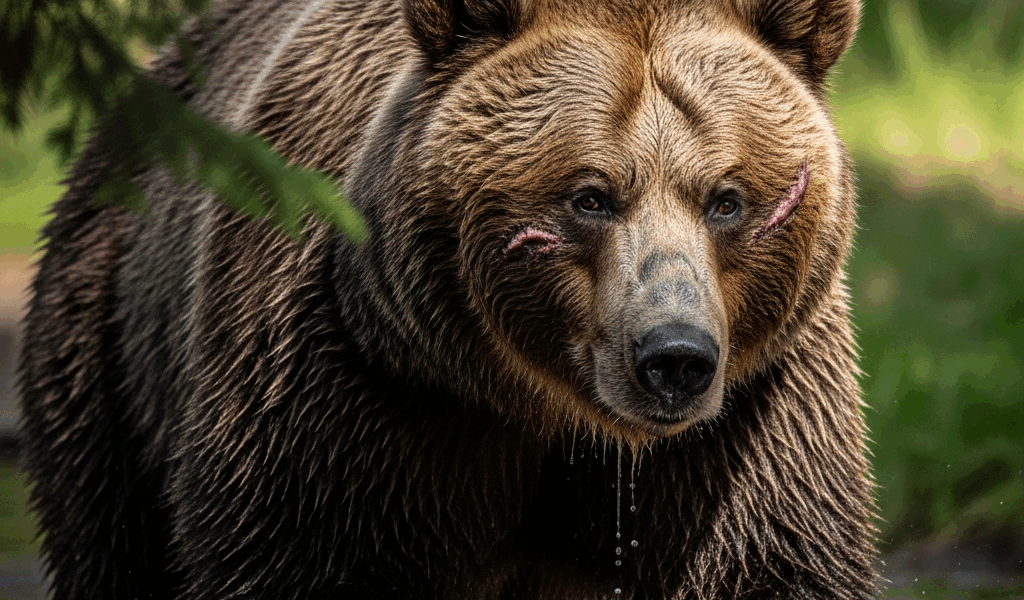
Scar patterns are the closest thing bears have to fingerprints. In essence, they’re permanent marks that accumulate over a bear’s lifetime. But they’re much more than that.
Bears accumulate distinguishing marks constantly — fight wounds from mating season battles leave parallel claw marks across the face and shoulders. Bite wounds on the ears are nearly impossible to heal without scarring. Environmental wear from rubbing against rough tree bark, encounters with porcupines, injuries during territorial disputes — all of it creates permanent disfigurements that researchers can photograph and catalog.
Field researchers photograph bear ears and facial profiles systematically. They aim for specific angles: direct profile shots of the head, close-ups of both ears, and frontal face images. The ear itself is the gold standard. Shape variation between bears is enormous. Some have torn tips from frostbite or fights. Others are cropped short on one side. Researchers compile ear photographs into reference catalogs — sometimes numbering 50 to 200+ individuals in a studied population.
Brown bears (*Ursus arctos*) are dramatically easier to identify this way than black bears (*Ursus americanus*). Black bears have smaller ears and less pronounced facial structure. Scar accumulation takes longer to manifest visibly. I’m apparently someone who gets frustrated comparing research protocols — brown bear studies in coastal Alaska can reliably identify 85–90% of photographed individuals by scars alone. Equivalent black bear studies achieve maybe 60–70% confidence without additional markers.
Poor lighting wrecks this methodology. Scars that appear obvious in bright midday sun vanish in shadow. Research photos taken during overcast days or in dense timber often require revisiting or discarding. Winter coat changes complicate things further — as bears lose summer fur and grow thick winter pelage, scar visibility shifts dramatically. A researcher photographing a bear in October sees different scar prominence than the same bear in March.
Probably should have opened with this section, honestly. The scar method is by far the most commonly used technique, and it’s genuinely elegant in its simplicity. No equipment failure. No need to recapture. Just a camera and field notebooks.
Body Size, Coloration, and Fur Pattern Recognition
Estimating bear size in the field is deceptively hard. Absolute measurements are impossible without proximity.
A 250-pound bear 100 meters away can appear smaller than a 180-pound bear standing 20 meters away. Perspective distortion makes naive size assessment worthless. What researchers actually use is relative size — comparing individuals to landscape features, to known reference bears within the same observation period, or to body proportions rather than overall mass. A bear’s shoulder hump height, head size relative to body, and leg thickness become identifiers when photographed against consistent reference points. Some researchers use the diameter of nearby trees or rock formations as scale references when capturing footage. It’s not precise, but combined with other markers, it works.
Fur coloration varies considerably within species. Some brown bears are nearly black; others are blonde or reddish-brown. Black bears sometimes display cinnamon or even whitish guard hairs. These variations are heritable and stable across the bear’s lifetime — unlike scar patterns, which accumulate over years. That’s what makes color patterns particularly useful for young bears.
Patch patterns also matter. Bears sometimes develop distinctive lighter or darker patches on the chest, back, or flanks. These persist for years. One Yellowstone grizzly female nicknamed “Blondie” was recognized across two decades partly because of her overall pale coloration combined with specific white patches on her chest and face.
The limitation here is aging. Young bears of both sexes look similar. Sexual dimorphism in bears is less pronounced than in primates — I’m apparently the type who notes these things. It’s easier to visually distinguish a male baboon from a female (body size difference can be 2:1) than to distinguish a three-year-old male bear from a four-year-old female. This creates genuine identification errors, especially for subadult bears in their first 3–4 years of independence.
Seasonal variation also presents challenges. Bears in spring look lean and angular after winter denning. Fall bears are bulky and rotund after salmon or whitebark pine feeding. The same individual can appear dramatically different month to month. Don’t make my mistake of assuming a spring sighting and a fall sighting are different bears just because the body composition shifted so dramatically.
Recording Vocalizations and Behavior Signatures
This method gets less attention than it deserves. Some researchers identify bears by territory-specific roars or long-distance vocalizations.
Brown bears produce low-frequency calls during mating season. Individual variation in pitch, duration, and harmonic structure can distinguish animals — similar to how wildlife biologists identify gibbons by distinctive morning calls or elephants by rumble frequencies. While you won’t need expensive equipment to start, you will need a handful of specialized tools. Autonomous recording units (ARUs) — weatherproof devices with directional microphones — can be left in bear habitat for weeks. Researchers return to retrieve audio files, then analyze spectrograms to identify individual vocalization patterns. That is because acoustic signatures remain consistent across seasons, which is exactly what makes them valuable for long-term population monitoring.
Movement patterns and behavior signatures also work. A bear that consistently returns to a particular berry patch early in the season, or a male that patrols a specific drainage system during breeding season, becomes recognizable through repeated observations. These behavioral signatures lack the precision of scarring or acoustic analysis, but they provide corroborating evidence when combined with other methods.
The catch? Vocalizations and behavior signatures only work when research protocols involve repeated, close-proximity observations. They’re less useful for population surveys where researchers conduct occasional long-distance sightings. That limitation constrains their practical application.
The Limitations Researchers Face in the Field
No single identification method achieves 100% reliability. Weather is the primary culprit.
Heavy snow obscures scars. Fog eliminates visual identification entirely. Rain reduces photo quality. I’ve seen research seasons where bad weather windows compressed usable field days by 40–50%. A bear photographed during a brief clear period becomes unidentifiable if the next sighting occurs during overcast conditions. First, you should plan for this volatility — at least if you’re designing a multi-year study.
Young bears present a specific problem. Subadult brown bears — ages 2–4 — have minimal scar accumulation. They’re still growing, so size comparisons shift month to month. Coloration patterns haven’t fully matured. Population surveys of denning areas where many cubs are present become exercises in frustration. You photograph 30 bears and can confidently identify maybe 12.
Migration and dispersal disrupt baseline data. A bear identified in one valley in June might appear in an adjacent valley by August after traveling 50+ kilometers. Without continuous tracking, researchers can’t definitively confirm the same individual — scar patterns help, but if photographs don’t overlap perfectly, doubt creeps in. That ambiguity matters more than you’d think when building population estimates.
Human error compounds these limitations. Photo quality varies wildly depending on camera equipment, operator skill, and field conditions. One researcher’s “definite match” for scar pattern might be another researcher’s “possible match.” Training protocols help, but subjectivity persists. The best research programs employ blind photo matching — researchers compare images without knowing prior identifications — to test consistency.
This is why modern bear research combines methods. A bear gets identified through initial scar analysis, confirmed through relative size comparison, cross-checked against coloration patterns, and further verified through acoustic recordings if available. The redundancy catches errors that any single method would miss.
Understanding these real-world complications transforms how you read bear research papers. When a study reports identifying 89% of brown bears in a population without physical capture, recognize that this represents thousands of hours of fieldwork, trained photograph analysts, and acceptance of some irreducible uncertainty. The method works because it’s robust enough, not because it’s perfect.
“`




Leave a Reply