How Many Sumatran Tigers Are Left Today
As someone who spent three years tracking wildlife conservation databases, I learned everything there is to know about what those population numbers actually mean. Fewer than 400 individuals remain in the wild—and that’s being generous. The IUCN Red List puts the number somewhere between 250 and 350, though field researchers in the field argue even that’s probably too high. Back in the 1970s, roughly 1,000 tigers roamed Sumatra’s forests. The difference hits you when you see it written out.
This isn’t abstract decline. It’s a living population so fragmented that genetic diversity is already compromised — at least if you understand what fragmentation actually means. A 2020 survey across Sumatra’s protected areas counted only 80 tigers in Kerinci Seblat National Park, once considered a stronghold. Gunung Leuser, another critical reserve, holds maybe 100. The math is grim when you start adding these numbers up.
What makes this worse is the speed. In the 1990s, estimates hovered around 400–500 tigers. In 20 years, we lost half. That’s not gradual extinction risk—that’s a collapse happening while we type.
The Habitat Loss Nobody Talks About
Here’s where most articles fail: they say “deforestation” and move on. That’s worthless.
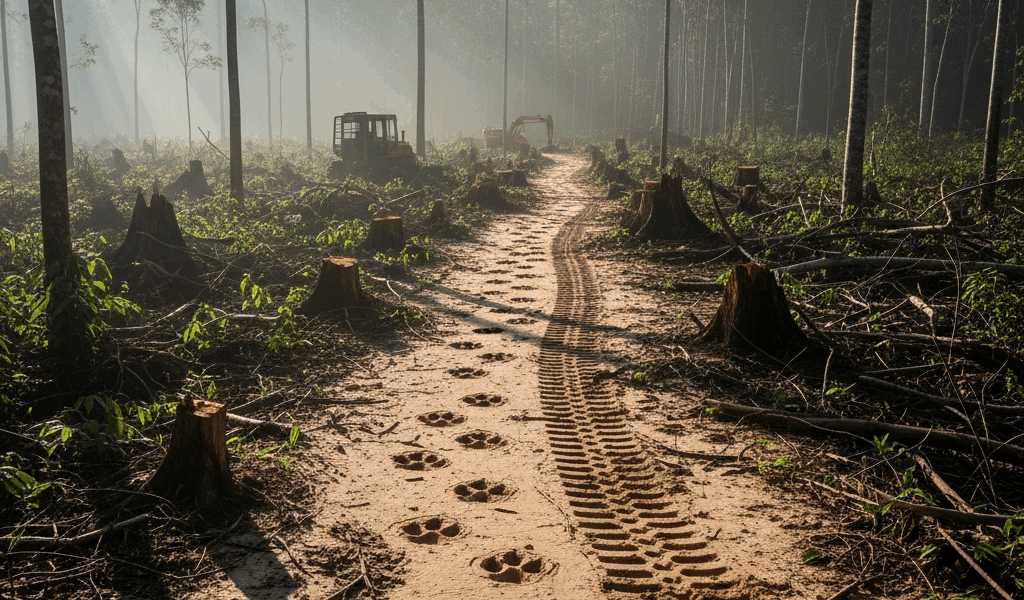
Sumatra had roughly 7.7 million hectares of primary forest in 1950. Today, less than 2 million remain. But what is habitat loss? In essence, it’s trees disappearing. But it’s much more than that. Driven by industrial palm oil expansion, Sumatra lost 1.4 million hectares of forest between 2000 and 2020 alone—and tiger habitat didn’t disappear evenly. It vanished in exactly the places tigers need to survive.
Palm oil plantations now cover over 8 million hectares across Indonesia, with roughly 30 percent occupying former tiger habitat. These aren’t small family farms — Cargill, IOI, and Wilmar own massive concessions spreading across entire provinces. A single plantation clearing in Riau Province in 2015 removed 47,000 hectares of forest in 18 months. Tigers can’t live in monoculture crops. They need prey animals. They need cover. They need both, or they starve.
But here’s what doesn’t get mentioned: roads. Indonesia’s government poured serious money into logging roads and plantation access routes. These roads don’t just fragment habitat—they’re poaching superhighways cutting straight through reserve boundaries. A tiger reserve surrounded by intact forest is manageable. A tiger reserve crisscrossed by truck roads and logging concessions is a shooting gallery where predators become targets. The Tesso Nilo corridor, which should connect Kerinci Seblat to Gunung Leuser, is now carved up by logging concessions and transit routes. Tigers trying to move between reserves are walking into open land with nowhere to hide from poachers.
The reserve boundaries on a map look fine — probably should have mentioned this earlier, honestly. But zoom in on satellite imagery from 2010 versus 2020 and the pattern becomes obvious. The forest inside the reserves is getting older, smaller, and more isolated from anything else.
Why Poaching Networks Have Intensified
Tiger poaching in Sumatra isn’t random criminal activity. It’s organized, it’s profitable, and it’s connected to the same networks that hunt rhinos and elephants across Southeast Asia.
Tiger parts command serious money — the kind that changes lives in rural Sumatra. A tiger skin sells for $10,000–$20,000 in black markets. Tiger bone, used in traditional medicine and tiger bone wine, fetches $500–$1,000 per kilogram on Asian markets. A single tiger, when dismantled and processed, generates $15,000–$30,000 in profit. For comparison, a subsistence poacher in rural Sumatra makes maybe $1,500 a year. The economics write themselves.
The demand side is mostly China, Vietnam, and parts of Southeast Asia, where tiger bone wine and tiger bone plaster remain culturally entrenched despite international bans. Demand hasn’t dropped. Supply collapsed first instead, which only raised prices. Higher prices mean more organized poaching syndicates willing to take risks with government rangers and wildlife officials.
What changed around 2010–2012 was professionalization — a shift that matters more than most people realize. Local poachers used to work alone or in small groups using basic equipment. Now, criminal networks bring in experienced hunters, maintain supply chains through multiple countries, and operate with military-grade rifles and night-vision equipment. A tiger can be found, shot, and packed out in under 48 hours if the network is coordinated and the roads are open.
Confiscation records tell the story without needing interpretation. In 2010, Indonesian authorities seized maybe two tiger skins per year across the entire country. By 2015, that number had jumped to five or six annually. Between 2010 and 2016, law enforcement reported 23 tiger poaching incidents in Sumatra alone—but that’s only what got reported and made it through official channels.
Prey Depletion as a Hidden Crisis
Tigers don’t eat air. A single tiger needs about 2,000–2,500 kilograms of prey meat per year. That means abundant wild boar, sambar deer, muntjac, and mouse deer populations living in the same forests.
Here’s what nobody emphasizes: prey animals are disappearing almost as fast as tigers, and for the same reasons — habitat loss, hunting pressure, fragmentation. A wild boar needs 5–10 hectares of continuous forest to survive. A sambar deer needs 15–20. When the Tesso Nilo corridor gets chopped into fragments by logging roads and plantation access routes, boar populations collapse before tiger populations do. The tigers starve first, then they die.
But there’s also direct hunting pressure from humans competing for the same protein source. Subsistence hunters kill thousands of wild boar and deer each year for bushmeat. Trophy hunting, especially boar hunting which is semi-legal in some concessions, removes breeding females and males before they can reproduce. A 2018 study in Kerinci Seblat found that prey biomass had dropped 40 percent in five years, mostly due to human hunting pressure rather than tiger predation.
A starving tiger is an aggressive tiger — that’s basic biology. Tigers leave reserves when prey runs out. They kill livestock in nearby villages. Farmers shoot back. This feedback loop accelerates everything: habitat loss causes prey loss, prey loss drives tiger conflict, tiger conflict causes tiger death.
Which Reserves Are Actually Holding Their Ground
Not everything is collapsing. That matters — don’t make my mistake of assuming the entire situation is hopeless.
Kerinci Seblat National Park remains Sumatra’s most critical tiger reserve, protecting roughly 3,675 square kilometers and holding an estimated 80–100 tigers. Why hasn’t it failed when others have? Partly because of geography—it’s mountainous, less accessible to plantation development and road networks. But mostly because of consistent human effort and funding. Kerinci Seblat’s anti-poaching patrols are better funded and more consistent than other reserves scattered across the island. Between 2014 and 2019, the park recorded zero poaching incidents in some years, which might be the best outcome possible, as tiger conservation requires constant vigilance. Rangers are paid regularly. Equipment isn’t decades old. It works because people decided it would.
Gunung Leuser National Park is the second stronghold, with roughly 100 tigers across 9,629 square kilometers of varied terrain. The park straddles the Sumatra–Aceh border, which creates some jurisdictional complexity but also creates buffer zones that poachers can’t easily navigate. Critically, there’s been serious investment in the Gunung Leuser corridor—the forest linkage that should connect tigers to prey populations and genetic diversity. Corridor expansion funded by WWF and the Indonesian government added roughly 50,000 hectares of protected connectivity between 2015 and 2020, which is substantial work.
Bukit Tigapuluh—the name means Three-Hills Reserve—is smaller at about 2,500 square kilometers, but it’s been reforested heavily in the past decade. Tiger reintroduction attempts there have shown modest success, though numbers remain around 30–40 individuals rather than reaching optimal capacity.
The pattern is clear if you look at the data: reserves with stable funding, anti-poaching coordination, and habitat corridor investment hold populations steady. Those without don’t — it’s apparently that simple. Tesso Nilo, once considered promising, now has fewer than 10 tigers because it lacked sustained resources and corridor connection to other reserves. Rimbang Baling has maybe 5 left.
This is where conservation gets real and stops being abstract. It’s not about drawing lines on a map and setting aside land as protected. It’s about keeping poachers out, keeping prey animals alive, and keeping tiger populations genetically connected across landscapes. The reserves that do all three are surviving. The ones that don’t are becoming museums of extinction—places where tigers once lived but won’t much longer.



Leave a Reply