The Invisible Crisis Nobody Talks About
Pangolin populations have gotten complicated with all the extinction noise flying around. These creatures hold a grim distinction: they’re the most trafficked mammals on Earth. Not tigers. Not rhinos. Pangolins — and almost nobody notices. Yet if you asked ten people on the street what a pangolin is, you’d get blank stares from nine of them.
In 2019, authorities in Malaysia seized 18.5 metric tons of pangolin scales in a single bust. Sixty-five thousand animals. That shipment was destined for Vietnam and China, where pangolin scales command prices of $500 to $3,000 per kilogram on black markets. Let that number sit for a moment.
Why does pangolin trafficking fly under the radar? The answer is depressingly simple: they’re not cute. Pandas are adorable. Tigers are majestic. Pangolins are scaled, solitary, and difficult to photograph looking noble. Conservation attention follows charisma, and pangolins landed on the short end of that stick.
But what are the actual numbers? In essence, TRAFFIC estimates between 100,000 and 1 million pangolins are poached annually. But it’s much more than that. Some estimates run higher. Compare that to approximately 20,000 African elephants killed per year for ivory — a crisis that dominates headlines and celebrity campaigns. Pangolins are being eliminated at rates that dwarf most other endangered mammals, yet they’re footnotes in global conservation discourse.
How Scale Trafficking Fuels the Decline
Understanding why pangolins vanish so quickly requires understanding what poachers actually want from them. It’s not meat, though poachers will sell that as a secondary product. It’s the scales.
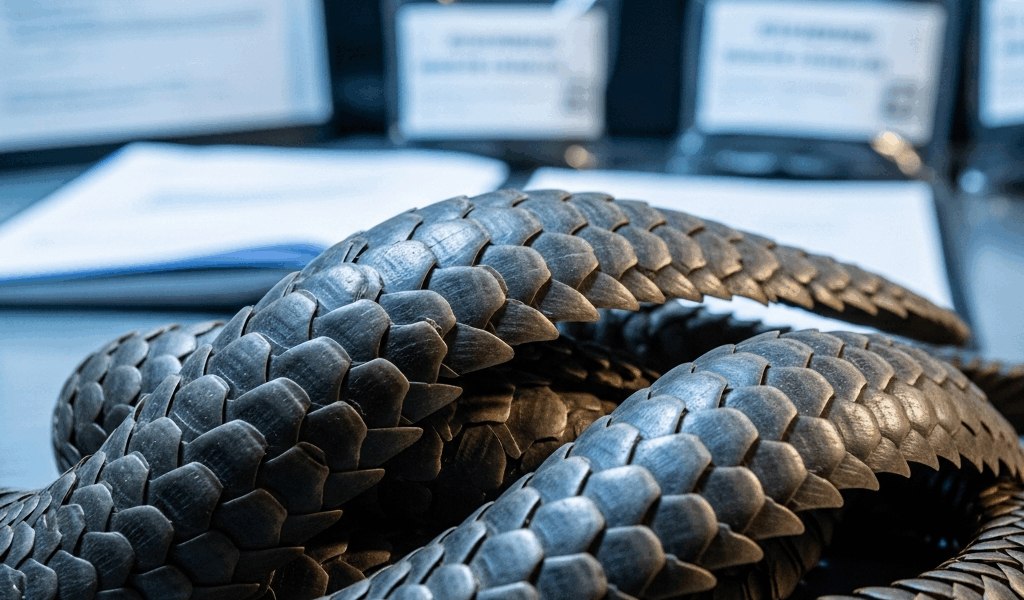
Pangolin scales are made of keratin — the same protein in human fingernails. They’re prized in traditional Chinese medicine for treating everything from arthritis to lactation problems. No scientific evidence supports these uses. That’s irrelevant. Demand exists. Supply gets harvested. Economics, brutal and straightforward.
A single pangolin might yield 150 to 200 grams of scales. At $500 to $3,000 per kilogram wholesale, that’s $75 to $600 per animal for poachers working in Southeast Asia or Africa. For people living on a few dollars daily, that’s irresistible income. A skilled poacher can catch two to three pangolins per night using dogs, snares, or by simply digging out their burrows.
The demand side matters more than the supply vulnerability, honestly. Pangolins are naturally solitary. They’re slow breeders. Females produce one offspring annually, sometimes once every two years. Population recovery takes decades under ideal circumstances. But demand is immediate, constant, and organized through sophisticated trafficking networks.
Frustrated by sparse enforcement, local poachers catch animals and sell them to middlemen for $20 to $100 each. Middlemen aggregate shipments and move them to major hubs in Vietnam, Laos, and southern China. The scales get processed, packaged, and sold to pharmaceutical companies and traditional medicine shops. The live animals go to butchers and restaurants. The whole operation runs with enforcement so sparse that getting caught is statistically unlikely.
Chinese customs records from 2015 to 2017 showed that the country alone imported over 400 tons of pangolin scales. That’s roughly 600,000 to 800,000 animals in three years. Just one country, just one time period, just what got officially documented. The actual volume is probably much larger.
Trafficking operations have become semi-industrial. They’re not run by desperate poachers working alone. They’re organized by networks with capital, transportation logistics, and protection from corrupt officials. A Vietnamese trafficker arrested in 2016 had facilitated the movement of an estimated 2,000 pangolins annually for over a decade.
Population Numbers Across Pangolin Species
Eight pangolin species exist globally. Four live in Asia. Four in Africa. All are declining. The Asian species are collapsing fastest.
The Chinese pangolin — once distributed across mainland China, Taiwan, and Southeast Asia — has been essentially hunted to extinction in its native range. Fewer than 10,000 individuals likely remain. The Sunda pangolin in Southeast Asia once numbered in the hundreds of thousands. Now? Unknown but critically low. The Philippine pangolin might have fewer than 50,000 individuals left. The Indian pangolin’s status is so murky that conservation biologists debate whether it’s declining or simply undocumented.
The African species face similar trajectories. The black-bellied pangolin and giant pangolin, found in Central and West Africa, are increasingly rare. The white-bellied pangolin is hunted so intensively that it’s become nearly impossible to estimate surviving populations. The Temminck’s ground pangolin remains relatively more numerous but is declining steeply in poaching hotspots.
Here’s what makes this comparison endearing to conservationists: mountain gorillas number approximately 1,000 individuals. Giant pandas number around 1,800. Both receive massive international protection, breeding programs, and conservation funding. Most pangolin species have lower populations than either of these flagship species, yet receive a fraction of the attention or resources.
The IUCN lists all eight pangolin species as either Vulnerable, Endangered, or Critically Endangered. Some species might have fewer reproductive-age animals left than breeding pairs in all existing zoos combined — and there are virtually no pangolins in zoos because they’re notoriously difficult to maintain in captivity.
What Conservation Efforts Are Actually Working
Doom narratives are easy. Solutions are harder. But real interventions are happening.
In 2016, China banned domestic pangolin scale trade. The ban didn’t eliminate demand, but it reduced legal cover for trafficking. More meaningfully, Vietnam followed with restrictions in 2018. These policy shifts matter because they shift enforcement from impossible to tractable.
Organizations like the International Union for Conservation of Nature, the Zoological Society of London, and smaller groups like the Pangolin Specialist Group have launched demand reduction campaigns in Vietnam and China. These campaigns target traditional medicine practitioners directly — showing them that alternatives exist and that pangolin scales aren’t actually more effective than substitutes. One 2018 survey found that consumption of pangolins in Vietnam had declined significantly among urban populations.
Enforcement operations have intensified. In 2018, a regional task force in Southeast Asia coordinated simultaneous raids that resulted in the seizure of over 1,000 live pangolins and multiple tons of scales. When enforcement actually happens — when poachers face prosecution and trafficking networks get disrupted — supply does decrease, at least temporarily.
A few facilities in Vietnam and China have established small-scale pangolin rescue and rehabilitation programs. These aren’t breeding facilities. Pangolins reproduce so poorly in captivity that large-scale captive breeding remains impractical. Instead, they’re release and recovery centers where confiscated animals are rehabilitated for potential reintroduction. Success rates are mixed, but the infrastructure is developing.
The most tangible win came in 2020 when CITES — the Convention on International Trade in Endangered Species — elevated all pangolin species to Appendix I, the highest protection level. This was largely symbolic in countries that ignore CITES, but it legitimized enforcement efforts where international treaties carry legal weight.
Why Pangolins Matter Beyond the Species
Pangolins eat ants and termites. Lots of them. A single pangolin can consume up to 70 million insects annually. This isn’t charismatic — it’s invisible work that happens at night in forests most humans never visit.
That work matters though. Termites and ants engineer soils. They affect water infiltration, nutrient cycling, and carbon storage. When pangolins disappear from ecosystems, termite and ant populations balloon. This triggers cascading effects: altered decomposition rates, changed vegetation structure, modified fire regimes in savanna systems. The collapse isn’t dramatic or obvious. It’s the slow, systemic rewiring of how forests and grasslands function.
Pangolins are also bioindicators. Their presence signals healthy, intact ecosystems with functional invertebrate communities. Their absence signals ecological stress. As poaching intensifies in particular regions, the loss of pangolins often precedes broader ecosystem collapse.
There’s also a public health angle, though it’s uncomfortable to mention. Pangolins carry coronaviruses — not the ones that infected humans, but related viruses in the same family. This matters because virus spillover risk correlates with habitat fragmentation and human-wildlife contact intensity. When you drive species to the edge of extinction, you concentrate them in smaller areas with more human activity, increasing spillover probability. Pangolins aren’t the source of human diseases, but they’re a warning system.
The pangolin crisis is ultimately a story about which animals we decide matter. We’ve decided that tigers and rhinos deserve our protection. We’ve somehow failed to extend that same conviction to creatures that are being hunted to extinction faster, quieter, and with less consequence. That gap between reality and attention represents a failure of conservation imagination. Fixing it requires the same element that saved some tiger populations and rhino populations: sustained human attention and political will. Pangolins have neither. Yet.




Leave a Reply